
Congratulations. You have reached the final stage of the hiring pipeline. After weeks of sourcing, screening, and intensive interviews, the hiring manager has made their decision. Now comes the most pivotal handoff: the job offer letter.
For talent acquisition teams, this document is far more than administrative paperwork; it is a critical operational touchpoint. If your offer letter format is disorganized, legally confusing, or simply slow to arrive, you risk losing your top choice to a faster, more organized competitor. A modern recruitment process must treat the offer letter as the culmination of a stellar candidate experience and the essential starting point for new hire onboarding.
In this guide, we break down exactly how to write a job offer letter that balances professionalism, legal protection, and candidate excitement. We have also included free, downloadable sample offer letters to streamline your operations.
What actually needs to be in a job offer letter, legally and practically?
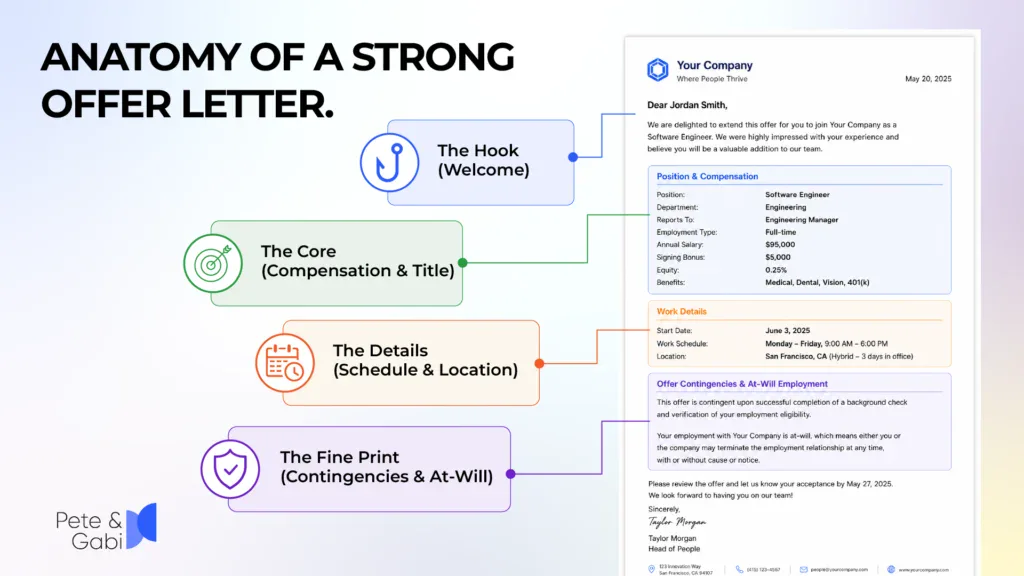
To ensure your offer is both practical for the candidate and protective for the company, it must contain a standardized set of core components. The goal is complete clarity, leaving no room for misinterpretations regarding compensation, responsibilities, or employment terms.
Practically, your letter must cover:
- Opening Congratulation: Start enthusiastically to build excitement.
- Position Details: Formal job title, department, and reporting manager’s name and title.
- Compensation: The exact salary (annualized or hourly rate), payment frequency (e.g., bi-weekly), and method of payment.
- Schedule & Location: Expected work hours, start date, and the primary work location (including specific hybrid or remote arrangements).
- Acceptance Instructions: A clear deadline for acceptance and instructions on how to return the signed letter.
Legally, your offer must strictly include:
- Contingencies: Employment must be explicitly conditional upon the successful completion of required background checks, drug screenings, or proof of eligibility to work (I-9 validation).
- At-Will Statement: In most US jurisdictions, you must explicitly state that employment is “at-will,” meaning either party can terminate the relationship at any time, with or without cause.
- Disclaimer: A statement that the letter is informational and does not constitute a legally binding employment contract.
What’s the difference between an offer letter and an employment contract?
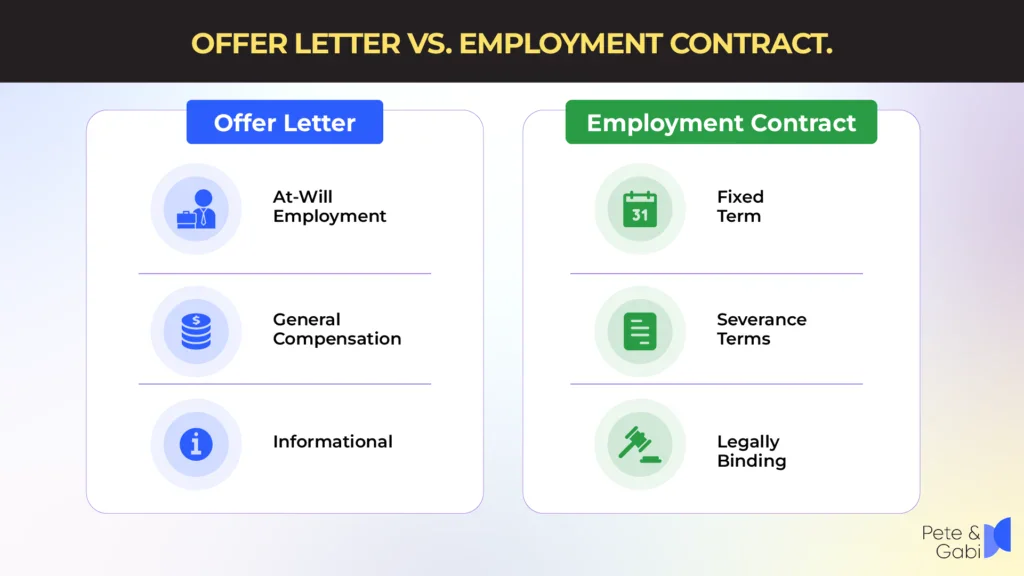
Confusion between these two documents is a frequent process failure that creates legal risk. While they may appear similar, they serve entirely different operational goals.
An offer letter is an invitation to work. It summarizes the key terms of employment in a simple, standardized format, but it is explicitly designed not to be a binding, long-term employment contract.
An employment contract (or employment agreement) is a legally binding, detailed agreement that specifies the rights and responsibilities of both parties. While offer letters highlight “at-will” status, an employment contract can create a fixed term of employment, dictate specific severance structures, or outline restrictive covenants (such as non-compete clauses). Always consult legal counsel to ensure you are utilizing the correct document for your jurisdiction and the seniority of the role.

What should you include beyond the basics to make an offer stand out?
The legal minimum keeps a company covered. It doesn’t do much to make a candidate excited. A few additions cost almost nothing and change how the offer actually lands: a short personal note from the hiring manager, a one-line reminder of why the candidate stood out, a plain-language summary of benefits instead of a link to a 40-page PDF, and a clear picture of what the first week looks like.
Candidates weighing multiple offers are reading between the lines for signs of how organized and how genuinely interested the company actually is. A generic template with the name swapped in reads very differently than a letter that sounds like it was actually written for them. Something as small as the hiring manager sending a two-line email alongside the formal letter, saying they’re genuinely looking forward to the person joining, tends to matter more than another paragraph of benefits copy.
What are the most common offer letter mistakes that create confusion or legal risk?
The most common mistake is vagueness around compensation: no clear base pay, no mention of bonus structure or commission if applicable, no stated pay frequency. Close behind it is a mismatch between what was said out loud in the final interview and what’s written in the offer, which creates confusion at best and a legal headache at worst.
Other repeat offenders: missing contingency language when a background check or drug screen is still pending, no clear offer expiration date (leaving the process open-ended while the candidate quietly keeps interviewing elsewhere), and copy-pasting a template from another state without updating it for local employment law. A remote hire based in a different state than the one on the template is a common way this slips through unnoticed until it becomes a compliance problem. None of these mistakes take long to fix. All of them are easy to miss when an offer gets rushed out at the end of a long hiring process.
How fast should you send an offer letter after a final interview?
Fast. Most candidates expect an offer within a few days of a final interview, and the strongest candidates, the ones with other options, are usually the least willing to wait around. A verbal offer on the call is good, since it removes the ambiguity of waiting on paperwork. A written offer within 24 to 48 hours is better, since it gives the candidate something concrete to act on instead of a promise to check their email later in the week.
This is really an extension of a broader problem: a slow hiring process bleeds strong candidates before an offer is ever sent. Reducing time to hire is the same discipline that keeps candidates engaged all the way through, and it pays off hardest right at the finish line.
The letter is the last step, not the whole process
The letter itself matters, but it’s really the last step of a longer process. The faster and more consistent that process is leading up to the offer, from first interview through final decision, the less likely a strong candidate has already said yes to someone else by the time your letter lands in their inbox. Rebecca keeps interview evaluation consistent from the first conversation onward, so there’s no last-minute scramble to confirm this is the right hire once it’s time to write the offer. And once that offer is signed, what actually happens next is worth planning for too.