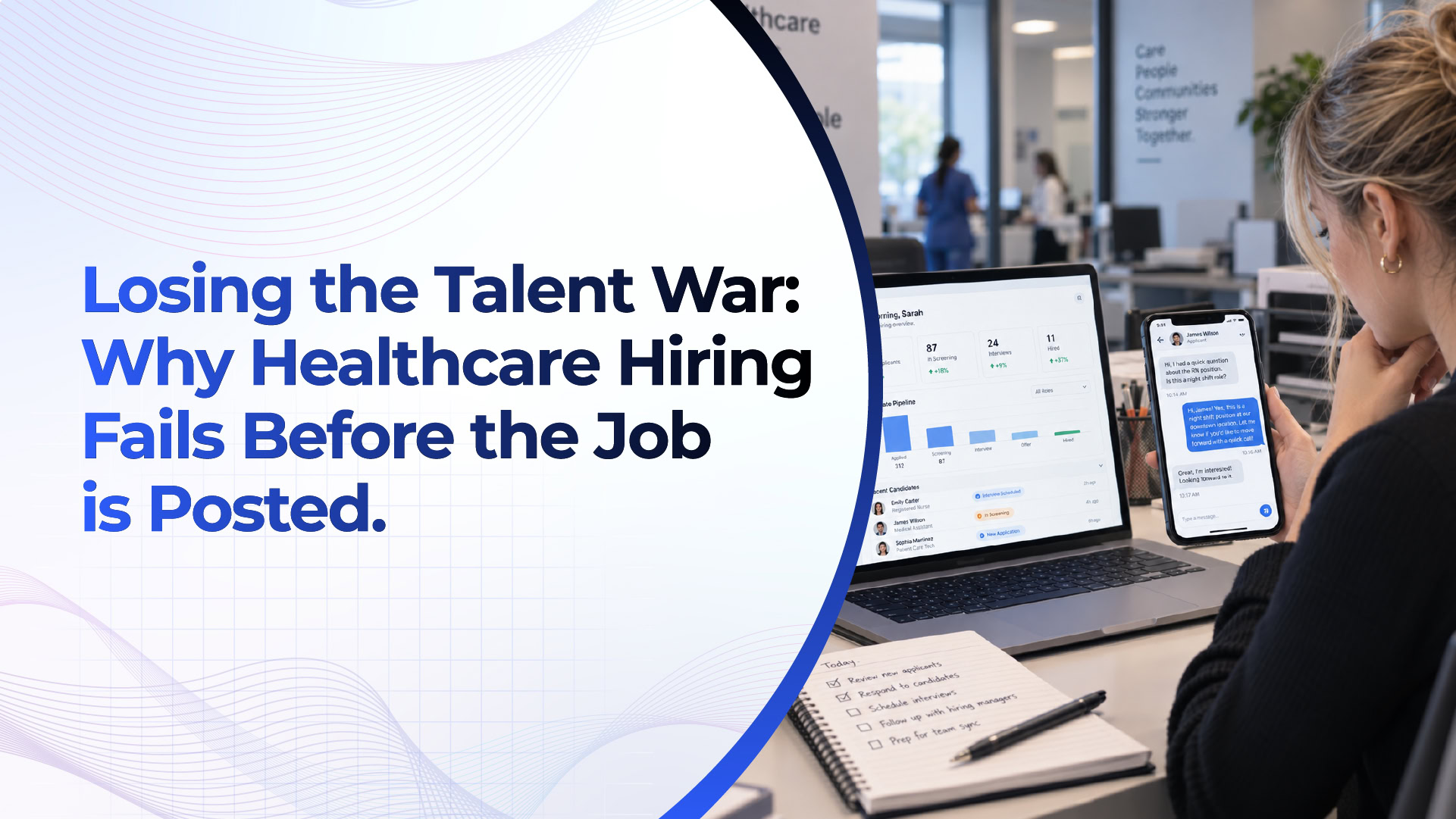
The traditional recruitment lifecycle is fundamentally broken in the healthcare sector. For years, hospitals, clinics, and private practices have operated on a reactive hiring model: wait for a vacancy, publish a job description on a generic job board, and wait for qualified clinicians to apply. In today’s hyper-competitive market, relying on this passive approach guarantees prolonged vacancies, skyrocketing premium labor costs, and severe staff burnout.
In 2026, the demand for qualified medical professionals vastly outpaces the available supply. Healthcare organizations are no longer just competing against the hospital across the street; they are competing against travel nursing agencies, telehealth startups, and corporate concierge medicine. In this landscape, the organizations winning the war for talent are the ones capturing candidates before a requisition is ever formally opened.
If your talent acquisition team is waiting for candidates to find your job posting, you have already lost. Building a proactive healthcare talent pipeline is the only sustainable way to survive the current staffing crisis. Here is why traditional healthcare recruitment strategies are failing and how to fundamentally restructure your approach to pipeline generation, candidate engagement, and speed-to-hire.
Why is the healthcare hiring shortage getting worse instead of better in 2026?
The healthcare staffing crisis is not a temporary pandemic hangover; it is a permanent, structural shift in the labor market. A combination of an aging patient population, mass retirements among experienced clinicians, and educational bottlenecks has created an insurmountable supply-and-demand gap.
According to 2026 Healthcare Workforce Projections issued by the Health Resources and Services Administration (HRSA), the national nursing shortage rate sits at approximately 8%. However, that national average masks severe localized deficits. The shortage is particularly acute among specific roles, with Licensed Practical Nurses (LPNs) facing a 20% deficit, and Registered Nurses (RNs) experiencing a 10% shortage. Simultaneously, the Association of American Medical Colleges (AAMC) projects that the United States will face a physician shortage of up to 124,000 providers by 2034.
These shortages are compounded by the fact that nursing schools and medical programs are actively turning away thousands of qualified applicants annually due to a lack of clinical sites and faculty constraints. The talent pool is artificially capped at the source.
Consequently, active job seekers—those unemployed and aggressively browsing job boards—make up a minuscule fraction of the available workforce. The vast majority of the talent you need is already employed elsewhere. They are passive candidates. Traditional “post and pray” job board strategies only reach the active minority, completely ignoring the passive majority. To fill these specialized roles, talent acquisition teams must transition to proactive outbound sourcing and long-term relationship building.
Why do qualified candidates disappear within 48 hours of applying?
One of the most frustrating phenomena for healthcare recruiters is “ghosting”—when a highly qualified candidate submits a resume and then completely vanishes, ignoring emails and phone calls just days later.
This rapid drop-off happens because clinical candidates possess unprecedented leverage in the 2026 labor market. According to recent industry data from 3bhealthcare, 55% of healthcare workers plan to actively job search or explore new opportunities this year. While they are open to moving, their tolerance for administrative friction is practically zero.
When a nurse or allied health professional decides to apply for a job, they typically apply to three or four organizations in a single evening. The moment they hit “submit,” a silent clock starts ticking. If your Applicant Tracking System (ATS) forces them to manually retype their resume, upload redundant credentialing documents, and take a 45-minute behavioral assessment before speaking to a human, they will abandon the process immediately.
Furthermore, if a candidate does complete the application, but your recruitment team takes four days to review the resume and send an interview invitation, that candidate has likely already completed a phone screen and received a verbal offer from a competing facility. They disappear within 48 hours because a faster, more agile competitor captured their attention first. In healthcare recruitment, ghosting is rarely a reflection of the candidate’s professionalism; it is almost always a reflection of your organization’s operational friction.
Is the real bottleneck sourcing volume, or response speed?
When hospital vacancy rates spike, the immediate reaction from departmental leadership is usually a demand for more candidates. They instruct recruiters to spend more money on job board sponsorships, launch new social media campaigns, and attend more career fairs to increase top-of-funnel volume.
However, in the vast majority of healthcare organizations, sourcing volume is not the actual bottleneck. The true point of failure is response speed.
Consider a talent acquisition team that successfully sources 100 qualified RN applications in a month. If the internal Service Level Agreement (SLA) allows recruiters 72 hours to review resumes, and hiring managers another five days to select candidates for interviews, the organization will likely convert fewer than five of those applicants into hires. The other 95 candidates were lost to faster competitors.
Instead of pouring more money into expensive nurse recruitment strategies to generate higher application volumes, talent acquisition leaders must relentlessly optimize their “speed-to-lead.” Treating candidate applications like inbound sales leads fundamentally changes the operational workflow. The goal should not be to collect resumes, but to initiate human contact with a qualified clinician within four hours of their application submission. In a talent shortage, velocity beats volume every single time.
How do you build a healthcare talent pipeline that doesn’t dry up between reqs?
Moving away from reactive hiring requires building a proactive talent community. A true healthcare talent pipeline is an always-on ecosystem of engaged professionals who have expressed interest in your organization, even if a specific role is not currently available.
To build a talent pool without waiting for more headcount, healthcare employers must implement three foundational strategies:
- Always-Open Requisitions: For high-turnover, evergreen roles (such as ICU Nurses, Medical Assistants, and Respiratory Therapists), the job posting should never be taken down. You must continuously capture inbound interest and screen candidates year-round so that when a clinician inevitably resigns, you already have three vetted replacements ready to interview.
- Silver-Medalist Re-Engagement: The candidates who made it to the final round of interviews but were ultimately not selected are your most valuable asset. They are already vetted, culturally aligned, and familiar with your brand. A structured pipeline requires recruiters to systematically nurture these “silver medalists” with quarterly check-ins, rather than letting their resumes die in the ATS database.
- Continuous Talent Mapping: Instead of waiting for a clinical director to leave before starting a search, talent acquisition teams should proactively map the market. By conducting talent mapping to build a pipeline before an open req, recruiters identify the top clinical leaders at competing local facilities and slowly build relationships with them over months or years.
Where does automation actually fit between sourcing and screening?
Automation in healthcare recruitment is often misunderstood. It should never replace the empathy and human connection required to recruit a burnt-out nurse or a highly specialized physician. However, automation is the only way to eliminate the administrative bottlenecks that cause organizations to lose candidates in the critical 48-hour window after they apply.
Automation belongs strictly in the operational transition space between top-of-funnel sourcing and human-led interviewing.
When a candidate applies, automated workflows should instantly parse their resume, verify their state licenses against primary source databases, and trigger a text message inviting them to self-schedule a phone screen if they meet the baseline criteria. This eliminates the days spent playing phone tag and manually cross-referencing credentials.
Once candidates are responding and engaged, the next massive bottleneck is screening them fast and consistently before they accept a counter-offer. By integrating intelligent screening technology like Rebecca AI Recruiter, healthcare talent acquisition teams can instantly apply structured, standardized evaluations to every applicant, 24/7. This ensures that hiring managers only spend their valuable clinical time interviewing fully vetted, highly qualified candidates, ultimately securing top-tier talent before the competition even opens their resume.