Marketing teams know the story well.
Campaigns to launch. Leads to nurture. Too many follow-ups to make. Analytics that don’t give the full picture.
And no matter what, they’re always expected to do more with less.
But as we sit on eve of 2026, one fact is becoming painfully clear—manual processes alone will no longer cut it.
Teams burn out, opportunities fall through the cracks, and competitors capture the leads their bandwidth doesn’t allow.
This is because AI marketing automation assistants are accelerating everything.
They’re handling the repetitive work, optimizing campaigns in real time, and freeing teams to focus on strategy and creativity.
In this blog, we break down the top nine AI assistants reshaping modern marketing. We cover their core capabilities, what they do well (and not so well), and the scenarios where each one will thrive in 2026 and beyond.
Why You Need AI Marketing Assistants
Marketing isn’t just about running campaigns anymore—it’s about running them faster, smarter, and more efficiently than your competition.
Here are the top reasons you can’t afford to skip AI marketing automation:
- Faster Execution, Faster Growth: AI assistants deliver tasks faster and optimize workflows instantly, keeping your marketing momentum on pace.
- 24/7 Nurturing across Channels: With always-on availability, AI marketing agents keep leads warm with timely follow-ups and automated engagement.
- Precision Targeting at Scale: AI analyzes behavior and audience patterns your team can’t find manually. This means targeting that yields higher campaign ROI.
- Lower Costs, Higher Output: AI agents handle repetitive tasks—list cleaning, segmentation, reporting—letting you achieve more without extra headcount.
- Real-Time Insights, Smarter Campaigns: AI marketing assistants provide instant performance tracking, giving you real-time analytics and optimization.
Keep reading as we break down the top AI Marketing Assistants in 2026 and when to bring them into your stack.
The Top Nine AI Marketing Automations Assistants
So let’s get to it—here are the platforms that deliver results.
1. Olivia by Pete & Gabi
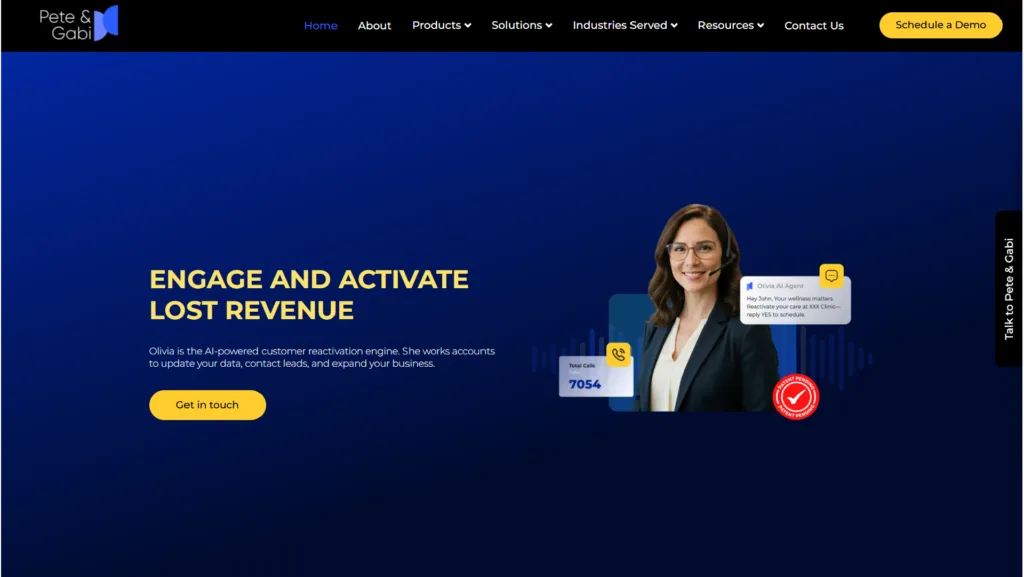
While Pete & Gabi’s conversational AI isn’t primarily designed for outbound campaigns, Olivia is engineered for something just as critical to your marketing ROI—engaging the leads you’ve paid for.
A consistent problem for businesses everywhere: revenue leaks happen after leads come in. Inquiries go cold in CRMs and never get a second follow-up.
This is Olivia’s purpose.
She was built for customer reactivation, dormant-lead recovery, and multi-step nurturing that is personal instead of scripted.
There are many AI tools out there for surface-level engagement, but Olivia successfully revives old pipelines, books meetings, and moves warm prospects right to your sales teams with full conversational context.
Key Features
- Natural AI-powered reactivation conversations
- Personalized win-back offers based on customer history
- Real-time objection handling and sentiment analysis
- Native CRM integration with automated data syncing
- 24/7 outreach across global time zones
- Detailed win-back analytics
- Multi-language conversation capability
Pros
- Easy setup without technical expertise
- Full customization of conversation flows and logic
- Highly scalable for enterprise needs
Cons
- Voice-first approach
- May be expensive for smaller teams
Best For
Marketing and revenue teams who want to recover missed revenue and keep their pipeline alive without increasing headcount.
2. Breeze by HubSpot
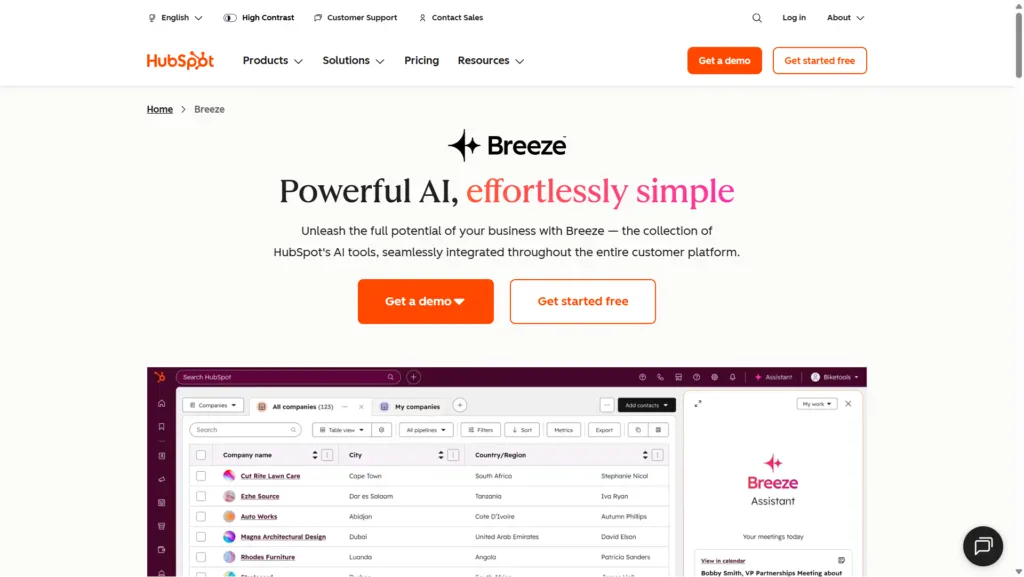
Breeze is HubSpot’s AI-powered marketing assistant built directly into its marketing, sales, and service hubs.
Designed to streamline workflows across the customer lifecycle, Breeze automates tasks like content creation, email sequencing, lead enrichment, and data entry.
For marketing teams already using HubSpot, Breeze is a natural extension—helping draft campaign copy, suggest optimal send times, score leads automatically, and surface insights from campaign performance data.
Breeze really thrives at marketing automation, but one knock is that it’s less conversational than dedicated AI voice agents. It’s built more for efficiency and less nuanced prospect engagement.
Key Features
- AI-powered content generation (emails, social posts, landing pages)
- Automated lead scoring and enrichment
- Campaign optimization suggestions
- Email sequence automation
- Native integration across HubSpot’s CRM, Marketing, and Sales Hubs
Pros
- Seamless integration if you’re already using HubSpot
- Reduces time spent on content creation and data entry
- Continuously learns from your marketing data to improve suggestions
Cons
- HubSpot-exclusive (not available for other platforms)
- Limited conversational AI capabilities for voice or live chat
Best For
HubSpot users who want to automate repetitive marketing tasks and optimize campaigns without leaving their existing platform.
3. Botpress
Next up is Botpress; an open-source conversational AI platform designed for teams that want full control over their chatbot and voice agent infrastructure.
Built for developers and technical marketing teams, this marketing automation platform lets you create highly customized AI agents for lead qualification, customer support, and marketing automation.
It supports multi-turn conversations, integrates with external APIs, and allows you to train AI models on your own data.
And unlike SaaS platforms with locked ecosystems, Botpress gives you access to the underlying code—so you can build exactly what you need, deploy on your own tech stack, and avoid vendor lock-in.
Note that their automation platform requires technical expertise to set up, optimize, and maintain. It’s not a plug-and-play solution.
Key Features
- Open-source conversational AI framework
- Full customization of conversation flows and logic
- Multi-channel deployment (web, mobile, voice, messaging apps)
- API integrations with CRMs, databases, and third-party tools
- Self-hosted or cloud deployment options
Pros
- Complete control over AI behavior and data
- Highly scalable for enterprise needs
- Active developer community and extensive documentation
Cons
- Requires technical expertise for setup and maintenance
- Steeper learning curve than no-code alternatives
Best For
Technical marketing teams and enterprises that need fully customizable conversational AI and want control over infrastructure, data, and AI training.
4. Zapier AI
Zapier AI is an automation assistant designed to connect marketing tools, trigger workflows, and execute multi-step tasks across thousands of apps.
Rather than building complex automation workflows manually, marketing teams can simply tell Zapier AI what they want and let the AI handle the rest.
For instance: “When a lead fills out this form, add them to Mailchimp, send a Slack notification, and create a HubSpot contact.”
For marketing teams juggling fragmented tech stacks, Zapier AI acts as a universal connector—syncing data between CRMs, email platforms, ad tools, analytics dashboards, and more.
And while Zapier AI excels at workflow automation, it’s not a conversational AI agent. Zapier exists to orchestrate backend processes that support marketing operations.
Key Features
- Natural language automation builder
- Connects 6,000+ apps and marketing tools
- Multi-step workflow automation (Zaps)
- Real-time data syncing across platforms
- Pre-built templates for common marketing tasks
Pros
- Eliminates manual data transfer between tools
- Easy setup with no-code interface
- Massive app ecosystem (virtually any tool integrates)
Cons
- Not a conversational AI (doesn’t engage prospects or customers)
- Can get expensive as automation complexity increases
- Requires thoughtful workflow design to avoid errors
Best For
Marketing teams with fragmented tech stacks that need seamless automation between tools, data syncing, and workflow orchestration without coding.
5. Relevance AI
If your marketing team wants custom AI agents for lead research and data analysis, then Relevance AI is for you.
This platform is built for behind-the-scenes marketing tasks—using large language models (LLMs) to analyze campaign performance, segmenting lead data, and generating personalized content at scale.
In other words, it’s made to automate research-heavy processes.
With Relevance AI, marketing teams can automatically research prospects, pull competitive intelligence, generate email copy tailored to specific segments, or analyze customer feedback at scale.
Ultimately, it’s not a tool designed for real-time customer engagement but instead for operational efficiency behind the scenes.
Key Features
- No-code AI agent builder for marketing tasks
- Automated lead research and data enrichment
- Content generation at scale
- Data analysis and reporting automation
- Integration with CRMs, spreadsheets, and databases
Pros
- Automates time-consuming research and data processing
- Flexible for any marketing workflow
- No technical expertise required
Cons
- Not designed for live customer engagement or conversations
- Requires clear workflow design to maximize value
Best For
Marketing teams that need to automate data analysis and lead research at scale.
6. Chatsonic by Writesonic
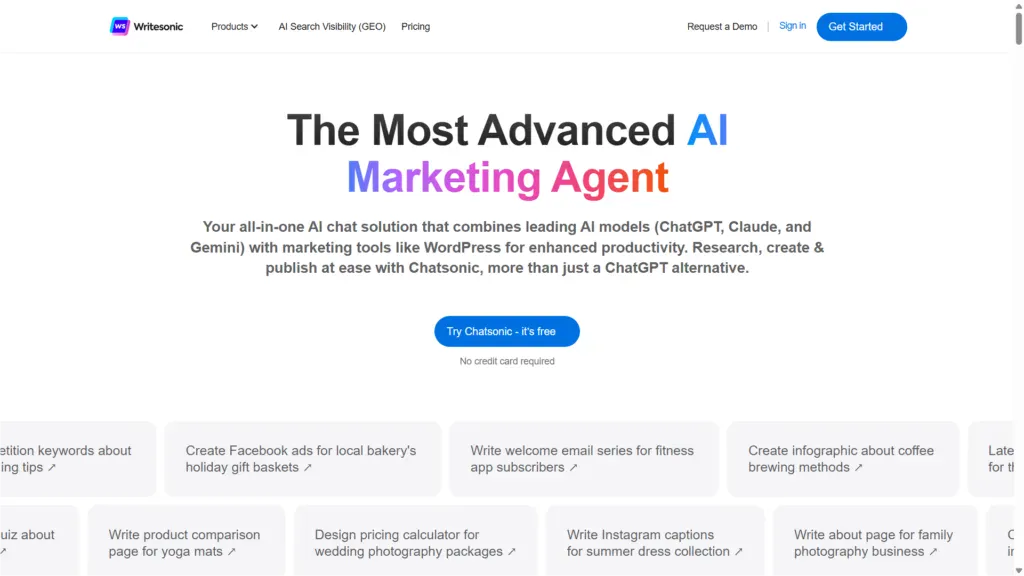
Struggling with content creation bottlenecks? This automation assistant is for you.
Chatsonic is an AI-powered content assistant designed to help marketing teams generate high-quality copy, brainstorm campaign ideas, and produce marketing materials faster.
Built on advanced language models with real-time web access, Chatsonic creates blog posts, social media content, email campaigns, ad copy, and landing pages based on natural language prompts.
And unlike static AI tools, Chatsonic can pull current information from the web—making it useful for trend-based content and news-driven campaigns.
Chatsonic accelerates content production without sacrificing quality, and can also generate images, summarize research, and assist with SEO optimization.
Key Features
- AI-powered content generation (blog posts, emails, ads, social media)
- Real-time web access for current information
- SEO optimization suggestions
- Image generation and visual content creation
- Multi-language content support
Pros
- Speeds up content creation significantly
- Affordable for small to mid-sized teams
- Easy to use with minimal learning curve
Cons
- Not designed for lead engagement or customer conversations
- Content requires human editing for brand consistency
Best For
Marketing teams that need to scale content production without expanding headcount, while staying on top of trends.
7. Watsonx by IBM
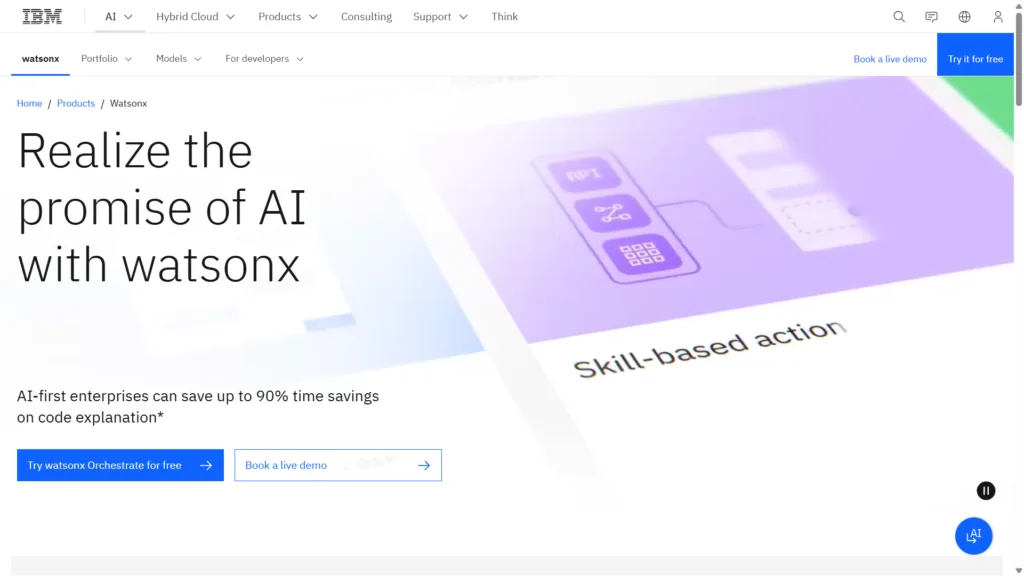
Watsonx is IBM’s enterprise AI platform designed for large organizations that need custom AI solutions for marketing, customer service, and business intelligence.
Unlike plug-and-play marketing tools, Watsonx is a development platform—allowing enterprises to build proprietary AI models, train them on internal data, and deploy them across marketing operations.
This includes conversational AI for customer engagement, predictive analytics for campaign optimization, and personalized content generation at scale.
As you might expect of an IBM offering, it is complex, expensive, and requires significant technical resources. It’s not for small teams or quick deployments.
Key Features
- Custom AI model development and training
- Enterprise-grade data security and compliance
- Conversational AI for customer engagement
- Predictive analytics and marketing intelligence
- Integration with IBM’s cloud infrastructure and third-party tools
Pros
- Full control over AI models and data
- Strong compliance and security features
- Comprehensive support from IBM
Cons
- Expensive and resource-intensive
- Requires technical expertise for setup and maintenance
- Long deployment timelines compared to SaaS tools
Best For
Large enterprises that need custom AI solutions and have the resources to build and maintain their own proprietary marketing AI infrastructure.
8. Synthesia
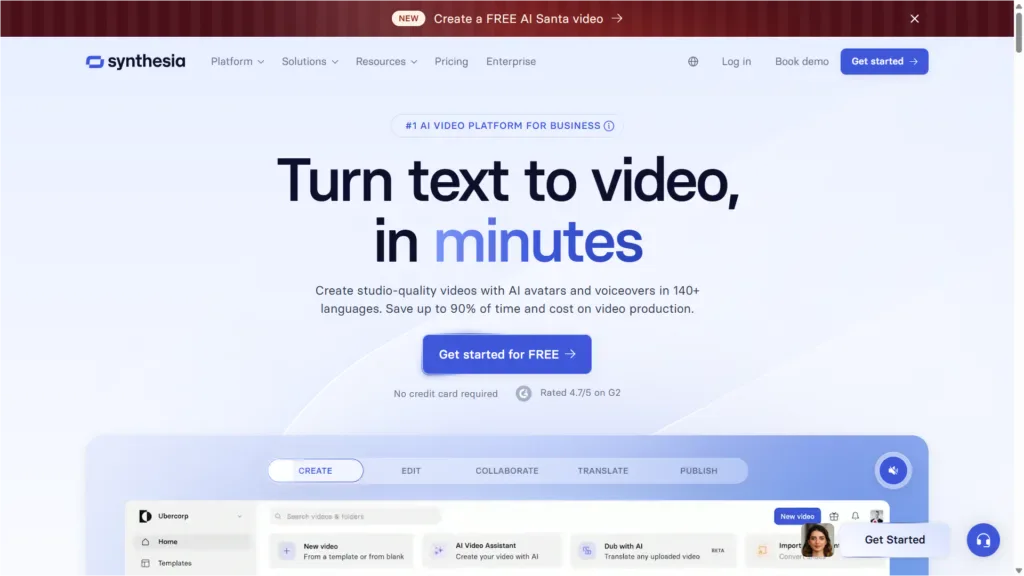
If your marketing team heavily relies on video content, Synthesia may be the platform for you.
It offers AI video generation tools designed to help marketing teams create professional video content at scale—without cameras, actors, or video production.
Using AI avatars and text-to-speech technology, Synthesia allows marketers to generate personalized video campaigns, product demos, training materials, and social media content in minutes.
You simply input a script, choose an avatar, and Synthesia produces a polished video in over 120 languages.
For marketing teams that need video content but lack production resources, Synthesia removes many traditional barriers and is especially powerful for localized campaigns.
Key Features
- AI-generated video with realistic avatars
- Text-to-speech in 120+ languages
- Custom avatar creation (using your own likeness)
- Templates for product demos, explainers, and ads
- Integration with marketing platforms for distribution
Pros
- Dramatically reduces video production costs and timelines
- Scales video content across languages and markets
- High-quality video output
Cons
- AI avatars can feel less authentic than real people for some audiences
- Best for content creation, not customer interaction
Best For
Marketing teams that need to produce high-quality video content at scale, localize campaigns globally, and eliminate traditional video production bottlenecks.
9. Jotform AI Agents
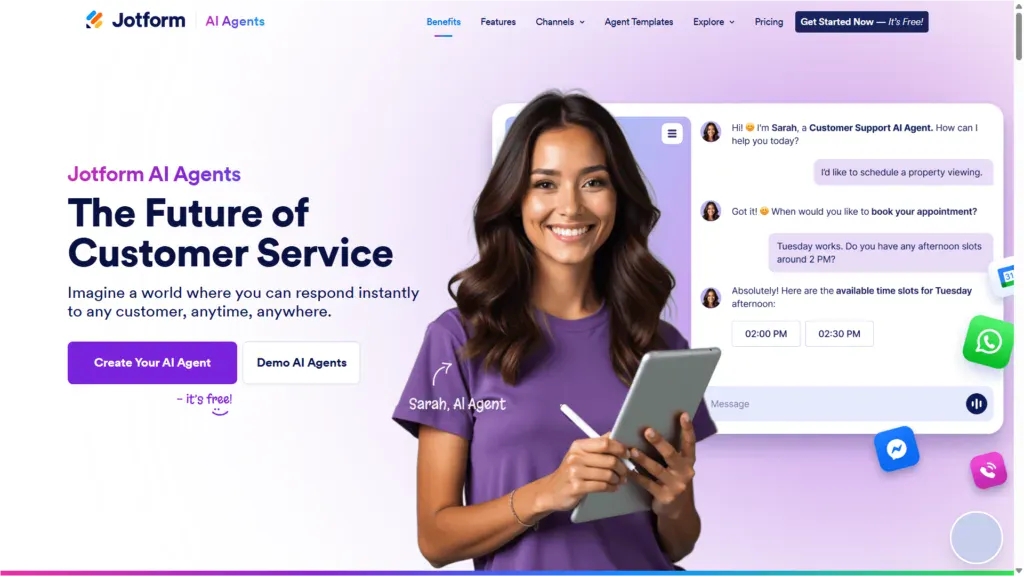
And finally, we have Jotform AI Agents.
This is a no-code platform designed to help marketing teams automate form-based workflows, lead capture, and data collection using conversational AI.
Rather than relying on static forms that prospects may abandon, Jotform AI Agents create interactive, conversational experiences that guide users through data collection.
Their agents can qualify leads, schedule appointments, process payments, and route submissions to the right team members—all without manual intervention.
For marketing teams running campaigns that depend heavily on form submissions (webinars, demos, lead magnets), Jotform AI Agents can reduce friction and increase completion rates by making data collection feel like a conversation, not a chore.
Key Features
- Conversational AI for form automation and lead capture
- No-code builder for custom workflows
- Integration with CRMs, email platforms, and payment processors
- Automated routing and follow-up triggers
- Mobile-friendly, embeddable forms
Pros
- Increases form completion rates
- Easy setup with no technical expertise required
- Reduces manual data entry and follow-up
Cons
- Limited advanced conversational AI capabilities
- Only effective for form automation
Best For
Marketing teams that want to replace static forms with interactive, conversational lead capture experiences and automate data collection workflows.
Selecting the Right Marketing Automation Assistant for Your Business
Here are some tips to help you evaluate your options:
- Identify Your Biggest Bottleneck: Is it lead capture, qualification, content creation, or campaign execution?
- Evaluate Integration Requirements: Does the new automation platform work with your existing marketing tech stack?
- Assess Your Team’s Technical Capacity: Can you deploy and maintain the AI marketing assistant with your company’s current technical team? Is hiring an option?
- Consider Budget and ROI: Does the pricing model align with how you’ll actually use it?
- Request a Pilot or Trial Period: Can you test the product before committing?
The Bottom Line
At the end of the day, the best AI marketing assistant for your business in 2026 is the one that removes your team’s friction points and delivers measurable results quickly.
We recommend focusing on solving the biggest problems costing you the most time, money, and pipeline velocity right now—whether that’s faster campaigns or 24/7 lead engagement.
If you’re ready to see what AI can do for your marketing engine, schedule a Pete & Gabi demo now.
FAQs
What exactly is an AI marketing automation assistant?
An AI marketing automation assistant is software that uses artificial intelligence to handle repetitive, manual, and time-sensitive marketing tasks, like customer segmentation, content personalization, lead nurturing, email follow-ups, and campaign management.
How can AI assistants improve my marketing ROI?
Smart automation reduces wasted spend, accelerates lead movement, and eliminates the manual bottlenecks that stall campaigns.
How long does it take to deploy an AI marketing assistant?
Deployment speed depends on complexity. Plug-and-play tools can be live in days, while more customizable platforms typically start at 1-2 weeks and scale up, depending on CRM integration, flow design, and testing. 
How do I measure ROI on AI marketing assistants?
Most marketing teams see measurable ROI within 90 days through higher conversion rates, lower cost per lead, and recovered bandwidth.