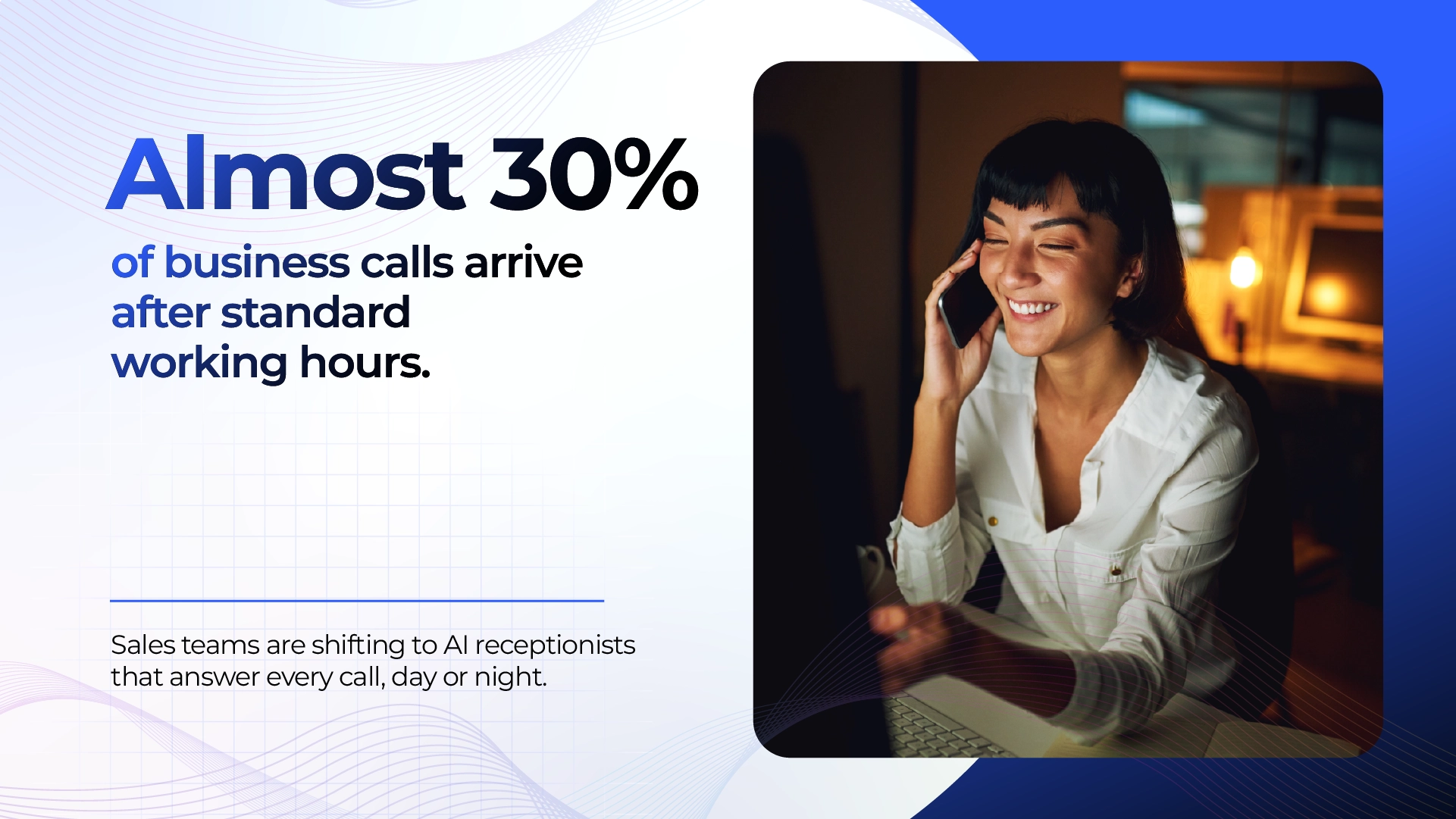
Every phone ringing in a business may either bring revenue or result in a loss. For most companies, however; they tend to suffer revenue losses. In fact, a 2026 analysis concludes that more than 28.5% of calls arrive after working hours in a business. In addition to it; it has been established that over half of the callers want immediate attention, rather than waiting until the following day. Every time a customer tries to call when no one picks up his call, he represents a potential lead at the companies that do not cover calls during after-hour working times.
An AI receptionist serves to eradicate this issue. Unlike a receptionist who is available for one call at a time, takes breaks and finishes work at 5 p.m.: but AI receptionist can answer calls instantly at any time of the day.
Why Inbound Calls Are the Highest-Value Leads You’re Not Capturing
Not all leads are equal. One person might be filling out a web form because they are browsing. Someone who picks up the phone and calls your company already has an interest; they just need to talk to someone. This is the reason phone leads have a conversion rate that is 10 times higher than leads coming from web forms, plus the reason why missing an answer on the phone is more costly than missing any other opportunity.
The issue is not related to willingness, but to the capacity to reply. Front desk workers must deal with walk-ins, calls, and emails simultaneously. Customer support teams work across several time zones. Salespeople are too busy, having meetings one after the other. As a result, the calls go to the mailbox; clients hang up and don’t leave a message, and by the time someone calls back, the lead has already contacted somebody else.
What Can an AI Receptionist Do?
The AI call assistant is more than just an advanced voicemail system or automated telephone answering system based on IVR technology. It is a CAI technology that can greet a caller in real time, interacting with them verbally in a natural manner, and determining their need, similarly to how a human representative would perform these tasks.
Here’s the typical flow:
- Instant answer: Calls are updated at any time during a day, meaning that the customer does not experience waiting in line for an answer before hanging.
- Natural conversation: An AI system relies on an automated program that can ask important questions to determine who calls, what the purpose is, and how urgent the demand is.
- Real-time qualification: The program assesses the quality of the calling since the caller answers the questions asked by the automated program.
- Objection handling: can be done for customers that hesitate to make a purchase. If a customer is confused by the pricing or timing issues, the automated program does offer solutions.
- Seamless handoff: The qualified leads that are of high interest should be passed to the sales staff for further processing.
- CRM logging: All documents are sent to the electronic storage automatically.
Olivia AI delivers this approach into practice by handling inbound calls, engaging prospects, and qualifying opportunities before handing them to sales teams. She ensures every caller gets an immediate response, even when your team is unavailable.
Traditional Receptionist vs. AI Receptionist: A Side-by-Side Look
| Factor | Traditional Receptionist | AI Receptionist |
| Availability | Business hours only | 24/7/365, including nights and weekends |
| Response time | Depends on staff availability | Instant, typically under a few seconds |
| Call capacity | One caller at a time | Unlimited simultaneous calls |
| Lead qualification | Inconsistent, depends on training | Standardized, data-driven scoring every time |
| CRM updates | Manual entry, often delayed or skipped | Automatic, real-time sync |
| Cost structure | Salary, benefits, turnover, training | Predictable subscription cost, scales on demand |
| Consistency | Varies by mood, fatigue, staffing gaps | Same quality conversation on call #1 and call #1,000 |
| Follow-up | Frequently deprioritized | Automated and persistent |
The table illustrates the point clearly. The thing here is not in the limited capabilities of the human reception service; it’s the limitation of the human service manager in terms of time, staffing, and resources. AI reception services removes all those limitations.
How AI Handles and Qualifies Calls
The benefit of an AI receptionist goes beyond simply answering calls; it is the effectiveness with regard to what occurs during the 60-90 seconds that follows the greeting. A competent AI operator is designed to ask the caller some of the same questions that a skilled sales development representative would commonly ask: What is the urgency of the caller? Does the person have a budget? What kind of issue is the person trying to resolve? Has the individual done business with an entity like the one being called?
On the basis of the responses given, the AI determines the intentions of the caller in real time. For example, a caller raising questions about pricing and wishing to schedule a meeting later in the week will attract completely different treatment than a person calling simply for brochures. The AI immediately passes the first caller to a live representative, while saving the second to be contacted afterward for follow-up meetings.
The Business Case: Why This Matters Beyond Convenience
The figures indicated above present the figure clearly. Since around thirty percent of calls are received in odd hours and at least fifty percent of the total callers are looking for immediate assistance, each hour when the phone lines are inactive is the hour of unfulfilled demand. Experts say that an average small service company loses around $100,000 a year because of unpicked calls. It is not accounting for the reputation loss since there is a piece of information proving that many negative online reviews mention something like a call kept unanswered.
The invention of the AI receptionist solves both issues at once. The AI receptionist ensures that almost all incoming calls are received and vetted immediately. This changes a previously unpredictable activity into a workable process. The sales departments no longer spend their time on cold calls because they get the warm leads immediately.
Getting Started with an AI Receptionist
When considering an A.I. receptionist for your company, there are a few aspects that are more vital than glamorous functions:
- Natural conversation quality where callers must feel that they are engaging with helpful individuals rather than a phone tree.
- Real qualification logic, not just any frequently asked questions of script.
- CRM integration so that no lead gets lost across the systems.
- A reliable human takeover so that every high intent caller can be directed to a live representative whenever necessary.
- Compliance and data safety, especially for regulated industries such as healthcare, finance, insurance, etc.
Solutions such as Olivia AI by Pete & Gabi are all centered on those aspects handling each incoming call instantly, qualifying leads onsite, and the only thing left for the representatives is to make a sale.
The Bottom Line
Each missed phone call is an opportunity lost. Approximately one-third of all phone calls come after business hours, and around 55 percent of callers want immediate help. For all of these reasons, the cost of inaction is underestimated by a majority of businesses. AI receptionists can help to solve that problem by providing immediate responses to calls, qualifying leads, and generating a steady flow of warm leads.