In the fast-changing world of talent acquisition, efficiency is no longer just a metric. It’s a competitive necessity. As applicant volumes rise and the financial impact of vacant roles increases, talent teams are seeking ways to process candidates faster while maintaining evaluation quality. This pressure has put automated conversational evaluation at the heart of the HR technology conversation.
But what if you pit conversational screening agents against experienced human professionals? Is the technology really mature enough to assess candidates or is it merely an overpriced resume parser?
If you’re a chief human resources officer (CHRO) or a talent acquisition leader evaluating your next technology investment, you want facts, not hype. This guide breaks down exactly where automated screening works best, where human judgment remains critical, and what the real financial ROI is when using these advanced tools in a real-world hiring pipeline.

What does “AI recruiter” actually mean, and how is it different from a traditional recruiter?
An ai recruiter is a conversational technology platform that autonomously engages, evaluates and advances job applicants thru the top of the funnel hiring stages.
While a human hiring professional utilizes manual resume reading, Boolean keyword searches, and scheduling 15-minute phone screens during normal business hours, a virtual talent assistant is a whole other ballgame. It combines state-of-the-art natural language processing and voice interaction to conduct dynamic, structured, interactive interviews. Instead of just scanning a static document, the digital assistant asks technical questions, evaluates spoken responses on the fly and scores the candidate against a standardized rubric.
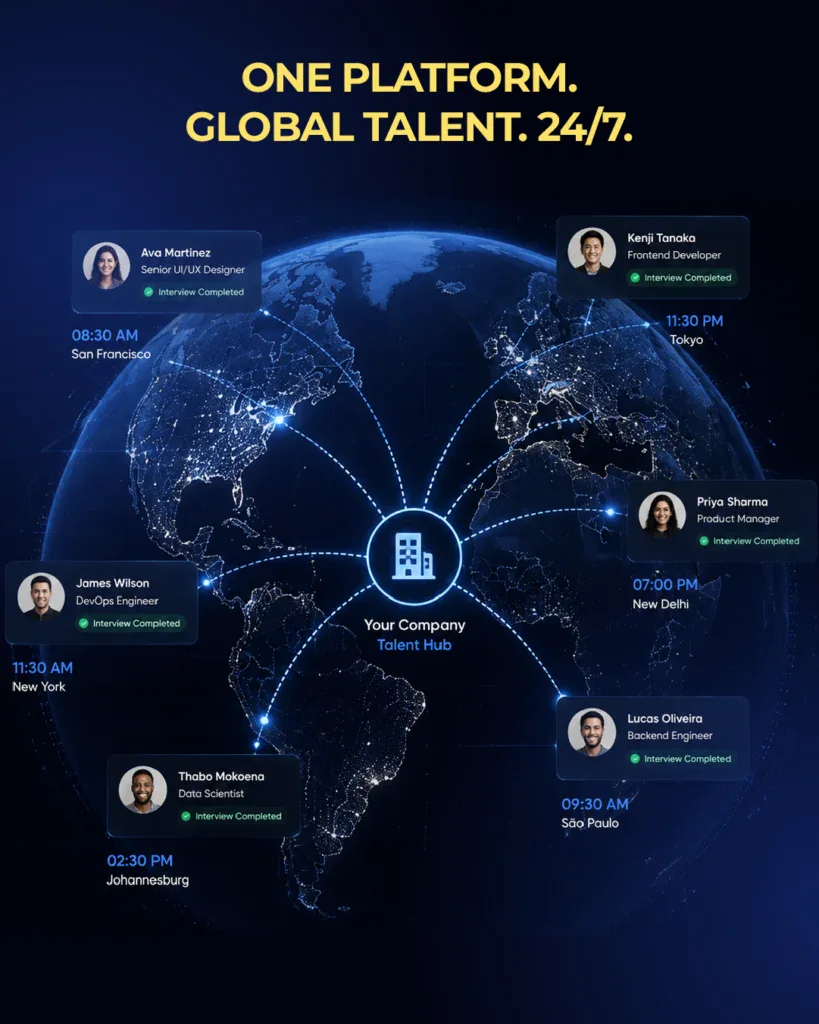
The main difference between ai recruiter vs traditional recruiter is the capacity of operations. Maybe 10 to 15 phone screens a human can physically do in a single workday. A conversational evaluation engine can conduct ten thousand interactive interviews in parallel, across time zones, without ever tiring.
Where does an AI recruiter outperform a traditional recruiter?
Digital interviewers have operational advantages over human team members in three key areas regarding pipeline velocity and scale:
- Unmatched Speed and Scalability: In high volume hiring environments such as retail, healthcare or enterprise technical staffing, human recruiters quickly become operational bottlenecks. An automated system skips the calendar coordination phase entirely. Candidates can complete a full voice interview the moment they submit an application, cutting an initial screening phase from weeks down to minutes.
- 24/7 Availability & Candidate Experience: The best candidates aren’t always applying between the normal business hours of 9 to 5. Passive candidates frequently update their profiles and browse job roles late at nite or on weekends. You can dramatically reduce candidate drop-off and abandonment rates by providing applicants with a link to complete an interactive screening call on their own time.
- Consistency and bias mitigation: Human interviewers are prone to cognitive fatigue, “similar-to-me” bias, and inconsistent mood levels throughout the week. A digital screening agent asks the same baseline questions in the same tone every time and scores the responses against the same objective rubric for every single candidate. This guaranties a fair and standardized top-of-funnel evaluation process
See what AI recruiting looks like in practice. Put Rebecca to work with your own hiring workflow and experience automated candidate screening firsthand. Start your free trial.
Where does a traditional recruiter still win (relationship-building, judgment calls, candidate advocacy)?
Despite huge advances in natural language processing, hiring is still a fundamentally human endeavor. Virtual talent assistants are not intended to replace seasoned talent professionals, but to assist them with delegation. In the subsequent situations, human recruiters quite decisively win when considering an ai vs human recruiter setup:
- Candidate Advocacy and Relationship Building: Convincing a highly sought-after passive candidate to join your organization requires empathy, persuasion, and a solid grasp of their career aspirations. A human being acts as a career counselor and advocate, establishing trust in ways that software cannot.
- The tough calls: Algorithms are good at checking technical competencies and structured qualifications, but they are not so good at judging nuanced soft skills, team chemistry and complex cultural alignment. But a human hiring manager is still needed to determine if a candidate’s specific working style will mesh with the existing department dynamics.
- Navigating Executive and Niche Hires: The pool of candidates is very small for c-suite placements or very niche technical roles. They want high-touch, white-glove service. An executive candidate is often a bad strategic move to screen via an automated call. These high-stakes placements require immediate human relationship management.
The Head-to-Head Comparison
| Evaluation Metric | The Traditional Recruiter | The Digital Screening Agent |
| Processing Speed | Limited to 10–15 phone screens per day. | Infinite concurrent capacity; thousands per day. |
| Cost-Per-Hire Impact | High fixed overhead (salary, benefits, software seats). | Very low marginal cost per screened candidate. |
| Availability | Standard local business hours, Monday–Friday. | 24/7/365 asynchronous availability globally. |
| Evaluation Consistency | Varies by recruiter experience, mood, and fatigue. | 100% standardized objective rubric scoring. |
| Candidate Reach | Restricted by manual sourcing bandwidth and time zones. | Instantly engages all inbound applicants simultaneously. |
| Human Judgment & Empathy | High; excels at selling the company vision and closing offers. | None; operates strictly as a technical and factual filter. |
What does the ROI of an AI recruiter actually look like, in hours and dollars?
When business leaders ask for the financial justification for investing in automated screening technology, it really boils down to pipeline velocity and administrative labor reduction.
The ai recruiter roi comes from removing the most time-consuming step of talent acquisition, calendar scheduling and top-of-funnel qualification calls. This phase is handed off to an automated system, which means companies are not paying their highly skilled human staff to leave voicemails and type up manual interview notes. In fact, research shows that some organizations realize up to 50% cost savings and 75% faster time-to-hire by effectively deploying automation.
The financial return is achieved quickly. But when we look at actual customer deployment data from the Rebecca AI platform, we see the real operational impact:
Verified ROI & Performance Metrics (Rebecca AI Published Data)
| Performance Indicator | Before Automation (Manual Process) | After Deploying Conversational AI |
| Time-to-Hire (Screening Phase) | 14 to 21 Days on average | Under 48 Hours (Up to 80% Reduction) |
| Cost-Per-Hire (Admin Overhead) | High labor costs for manual phone tag | Dramatically Lower (Up to 60% Lower Cost-Per-Hire) |
| Recruiter Bandwidth Spent on Admin | ~40% to 60% of the workweek | Near 0% (100% focused on final interviews) |
| Candidate Drop-Off Rate | High (due to scheduling delays) | Minimal (instant access keeps talent engaged) |
(Note: Data reflects published customer-deployment figures reported directly by Rebecca AI.)
Furthermore, companies also recover significant amounts of “empty seat” revenue by compressing time-to-hire. Getting a quota-carrying sales role or billable consulting position filled weeks sooner means the company is realizing weeks of direct revenue generation and massively compounding the software’s ROI.
Calculate how AI Recruitment will save your budget and increase your team productivity using our ROI AI Recruitment Calculator.
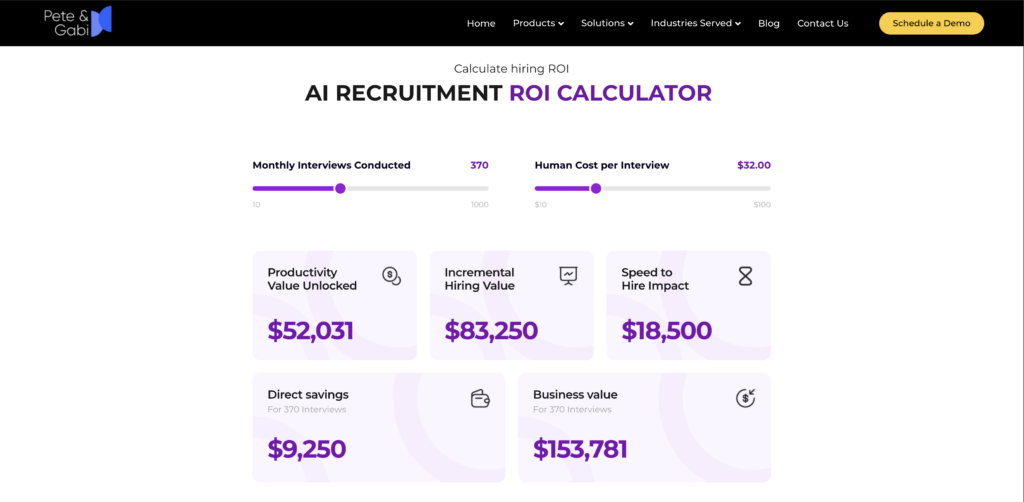
Want to see what these efficiency gains could look like in your hiring process? Schedule a demo of Rebecca AI and explore how conversational recruiting automation can fit into your existing workflow.
Is an AI recruiter meant to replace your recruiting team, or work alongside it?
The best talent acquisition teams operate on a “co-pilot” model. Smart leaders don’t see technology as a replacement for headcount. They see it as the best operational lever to protect human bandwidth. The greatest benefits of an AI recruiter compared to traditional recruiting are when the top of the funnel is handled by automation and the bottom of the funnel is handled by humans.
Operational Decision Tree: When to Lean on AI vs. When You Still Need a Human
| Candidate Stage or Scenario | Optimal Evaluation Method | The Strategic Rationale |
| Inbound Application Surge (High Volume) | Automated Digital Screener | Instantly process thousands of applicants to identify baseline qualifications without creating a massive backlog. |
| Passive Candidate Outreach & Sourcing | Human Professional | Crafting personalized outreach and convincing a passive prospect to take a meeting requires human persuasion. |
| Preliminary Technical Skill Vetting | Automated Digital Screener | Software can consistently ask technical questions and evaluate responses against a rigid, objective scorecard. |
| Final Cultural Fit & Chemistry Interview | Human Hiring Manager | Assessing how a candidate will interact with existing team members requires human intuition and empathy. |
| Offer Extension & Negotiation | Human Professional | Navigating counter-offers, benefits discussions, and closing the candidate demands a personal touch. |

What should you evaluate before choosing an AI recruiter?
The benefits of ai recruiter over traditional recruiting are vast when it comes to speed and data hygiene. However, successfully deploying these tools requires careful vendor selection.
According to Gartner’s research on HR technology trends, a staggering 75% of CHROs experience regret regarding their technology purchasing decisions. This dissatisfaction usually stems from unclear initial objectives, poor user experience design, or a failure to redesign internal processes to actually support the new technology.
When comparing an ai vs human recruiter hybrid setup, organizations must critically evaluate the software vendor across three main pillars:
- Explainability and transparency: Your team needs to be able to trust the decisions of the technology. The platform has to provide human-readable scorecards with a detailed breakdown of precisely why a candidate did or did not pass an interview and full audio transcripts.
- Deep ATS Integration: Automation for screening is useless if it creates a data silo in isolation. Make sure the platform integrates bi-directionally with your core Applicant Tracking System (like Greenhouse or Workday) so that candidate scores and notes sync automatically.
- Bias testing and compliance: The vendor must have third-party audit processes that rigorously test for bias in their natural language processing models to ensure that candidates are not penalized for accent, speech patterns or demographic background.
To explore how deploying advanced screening software can completely reshape your hiring workflows, read our comprehensive guide on how to automate your hiring pipeline.
COMPARE YOUR OPTIONS
Want to see how different virtual talent assistants stack up in real-world scenarios? Ready to make a data-driven, informed decision about your tech stack? Here’s our detailed technical breakdown of how Rebecca fares as the best digital interviewer vs. Alex.
By intentionally employing digital screening as a collaborative co-pilot, enterprise talent teams can eliminate administrative friction, significantly lower their cost-per-hire, and finally afford their human staff the time they need to do what they do best: build relationships and secure top talent.
Ready to see how Rebecca fits into your recruiting workflow? Start your free trial to experience AI-powered recruiting firsthand, or schedule a demo to explore how Rebecca can support your hiring team at scale.