Talent acquisition teams have an execution problem today. Applications per open role have tripled in recent years, but hiring budgets and team sizes have remained flat. Traditional Applicant Tracking Systems (ATS) do a good job of storing applicant resumes, but they do not do the work needed to screen, schedule and interview candidates.
AI recruiting software automates repetitive recruiting tasks that previously required manual work. By using specialized AI recruiting agents to handle repetitive top-of-funnel interactions, talent acquisition teams can access candidates 24/7, decrease candidate drop-off, and provide hiring managers with pre-qualified shortlists within hours, not weeks.
In this guide, we discuss how ai talent acquisition software automates the hiring pipeline, how conversational agents screen candidates, the measurable ROI of deployment, and how to choose the right platform for your company.
What is AI hiring software, and how is it different from an ATS?
AI hiring software is an automated recruitment tool that independently engages, screens, interviews, and evaluates job candidates using machine learning and natural language processing.
HR teams often lump all recruiting tools together, but there is a fundamental operational difference between an Applicant Tracking System (ATS) and modern ai recruiting solutions. The ATS is a passive database, while AI hiring software is an active execution engine.
System of Record vs. System of Action
An ATS is your hiring database. It has career pages, stores resumes in PDF format, tracks compliance records, and manages job requisition approvals. But an ATS requires human recruiters to manually click through each profile, send scheduling emails and conduct every screening call .
By contrast, ai recruitment automation tools serve as digital team members that do tasks directly. They reach out to passive candidates, conduct two-way conversation screening calls, answer applicant questions and automatically update candidate files.
According to Greenhouse’s Recruiting Automation Research, organizations can process high volumes of applications with intelligence built into early pipeline stages, without adding to administrative overhead or compromising on the quality of evaluation.
| Operational Capability | Traditional Applicant Tracking System (ATS) | Autonomous AI Hiring Software |
| Primary Purpose | Passive system of record for storing applicant files and compliance data | Active execution system for conducting screening, scheduling, and evaluation |
| Candidate Engagement | Requires manual recruiter outreach and email scheduling | Reaches out instantly 24/7 via conversational voice and messaging |
| Candidate Evaluation | Relies on keyword filters or manual resume reading | Evaluates contextual skill depth, experience relevance, and verified intent |
| Pipeline Acceleration | Administrative drag; candidates wait days for recruiter callbacks | Immediate candidate activation; shortlists delivered within 24–48 hours |
How do AI recruiting agents like Rebecca screen and interview candidates?
AI recruiting agents conduct natural two-way conversational voice dialogue to screen and interview candidates in real-time to assess technical skills, work history and role requirements.
Instead of sending candidates static multiple-choice questionnaires or having hiring managers watch recorded video files, platforms like Rebecca AI Recruiter act as an ai recruiting assistant that talks to applicants in real time.
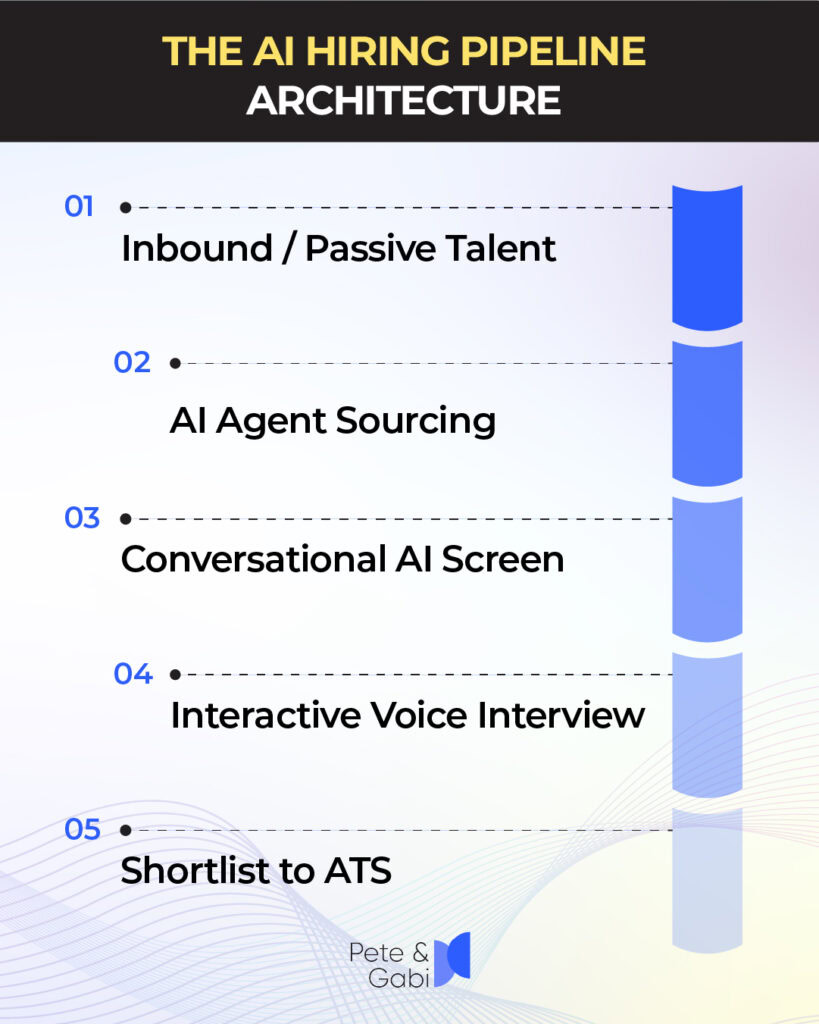
The Step-by-Step AI Interview Workflow
- Job Spec Calibration: The hiring team determines the core competencies, experience, pay ranges and technical specifications on the platform.
- Instant Outreach & Activation: As soon as an application is submitted, the ai hiring agent reaches out by phone or messaging and invites the candidate to do an instant screening call.
- Adaptive Conversational Evaluation : Conversational ai recruiting technology asks job-relevant questions, probes specific resume claims, and dynamically adapts follow-up questions based on candidate answers during the call.
- Synthetic Candidate & Fraud Detection: Advanced agents validate candidate identity and detect AI-generated voice deepfakes or profile fraud before live interviews.
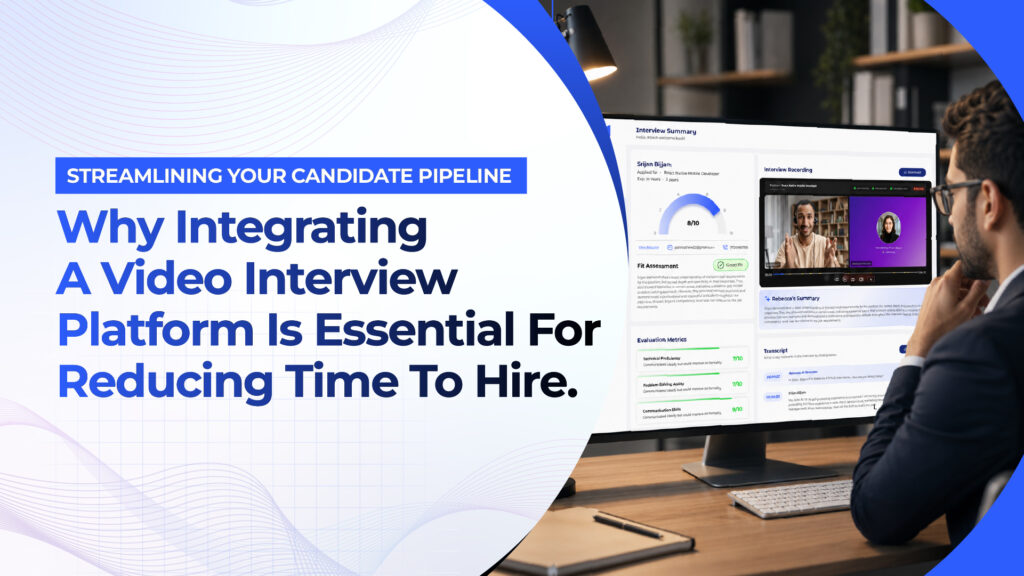
- Structured Scorecard Generation: The agent generates an objective scorecard immediately after the call listing verified competencies, salary alignment, and transcript notes, and automatically syncs the data into your ATS.
An ai hiring tool takes over the preliminary phone calls, thereby clearing resume backlogs and providing an immediate, interactive screening experience for every applicant.
What can AI hiring software actually automate (sourcing, screening, scheduling, interviewing)?
AI hiring software can automate top of funnel candidate sourcing, resume screening, calendar scheduling, preliminary voice interviewing and candidate scorecard reporting.
By automating repetitive tasks, these tools allow recruiters to focus on candidates and hiring strategy.
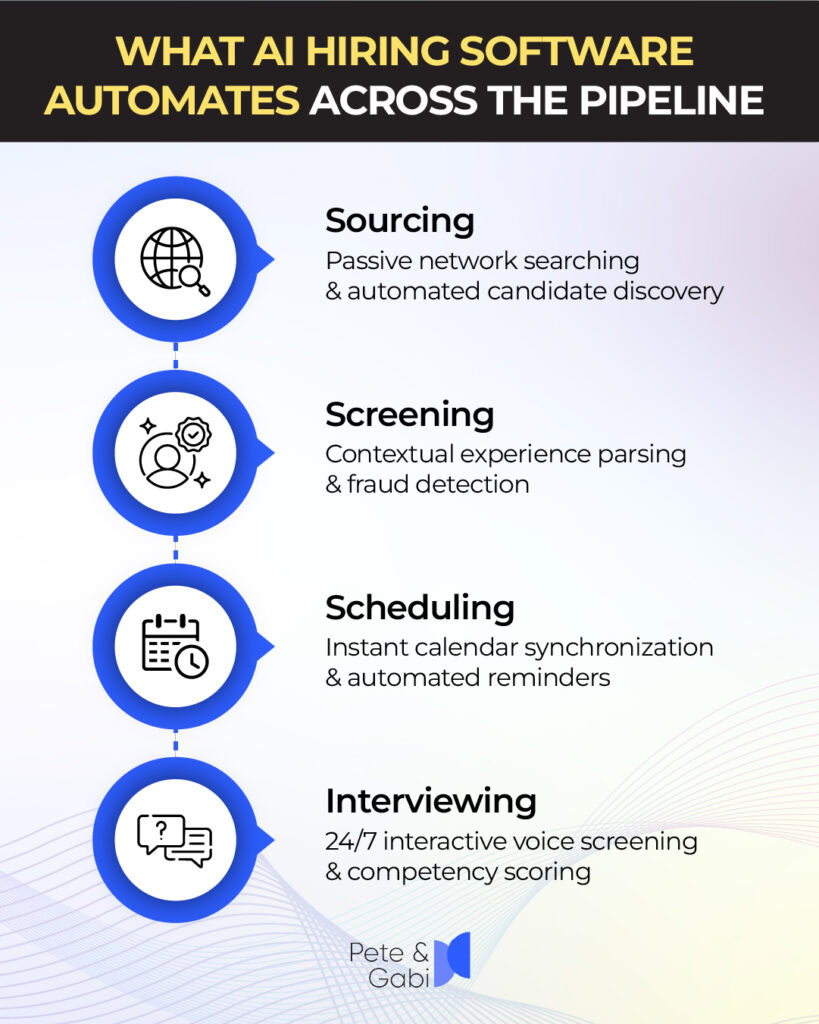
1. Passive & Inbound Candidate Sourcing
AI sourcing tools scour professional networks, job boards, and prior applicant databases to find qualified talent for new job requisitions. AI scans career paths and skills instead of searching for exact keywords to automatically generate quality candidates.
2. Resume and Candidate Screening Context
Instead of turning away qualified talent for missing keywords, ai talent acquisition software looks at the context of an applicant’s work history. It tracks skill growth, company size and project impact to precisely pinpoint high-fit candidates.
3. Frictionless Calendar Scheduling
One of the biggest reasons that hiring processes get delayed is the need to coordinate availability between the candidate’s calendar and the calendar of the person who is interviewing them. When a candidate qualifies, AI assistants immediately send self-scheduling calendar links, taking care of time-zone conversions and sending automated reminders to avoid no-shows.
4. Interactive Preliminary Voice Interviewing
Instead of recruiters doing 30 repetitive phone screens each week, an ai recruiting assistant conducts initial voice screens 24/7. Candidates are interviewed in the evening or on weekends, creating a faster pipeline flow.
What ROI can you expect from AI hiring software?
Using AI hiring software usually results in a 60-80% reduction in time-to-hire, a 70% reduction in cost-per-hire and 15+ hours a week saved for recruiters in administrative labor.
To measure return on investment, you need to consider both quantitative efficiency gains and qualitative enhancements to hire quality and candidate experience.
ROI Metrics that Autonomous AI Agents Use
- Reduced Time-to-Hire: Cuts initial screening windows from 14 days to less than 48 hours by reviewing applicants immediately upon submission.
- Recruiter Hours Reclaimed: Recaptures 10-15 hours a week per recruiter previously lost to phone tag, resume filtering and scheduling emails.
- Higher Interview Pass Through Rates: Structured, pre-qualified shortlists mean that hiring managers spend live interview time with only fully vetted talent.
- Zero Agency Overhead: Scale internal screening capacity with AI agents, reducing dependence on expensive third-party staffing agencies for high volume or niche roles.
In addition, studies of ai voice agents for recruiting show organizations deploying conversational screening engines achieve full software payback within the first 60 days after deployment by reducing empty-seat costs and administrative hours.
How to choose the right AI hiring software for your team?
To choose the right AI hiring software, you will need to evaluate its ease of integration, depth of conversational intelligence, standards for mitigating bias, capabilities for detecting fraud, and compliance features.
The Vervoe Software Selection Guide outlines a structured evaluation framework that talent leaders should follow when selecting vendors:
- Identify Core Operational Bottlenecks: Determine whether the main problem is top-of-funnel resume volume, slow phone screen scheduling, or candidate drop-off.
- Conversational AI vs. Form-Based AI Evaluation: How to tell basic text chatbots from real conversational voice engines. Interactive voice dialogue platforms provide much greater candidate engagement and deeper competency insights.
- Ensure Bi-Directional ATS Integration: Ensure the platform integrates natively with your existing tech stack (i.e. Greenhouse, Lever, Workday) so you don’t create disconnected data silos.
- Audit Compliance & Security Standards: Ensure vendors adhere to EEOC regulations and GDPR/CCPA requirements and provide clear, explainable AI scoring scorecards.
- Try the Candidate Experience: Request a live demo to see the candidate workflow in action and make sure the process is natural, respectful, and mobile accessible.
Is AI hiring software right for high-volume hiring, enterprise hiring, or both?
This software works for both high-volume and enterprise hiring, addressing the bottleneck of processing volume for high-turnover roles while ensuring ironclad compliance and evaluation quality for enterprise pipelines.
Both high-volume and enterprise hiring teams benefit from automation, although they use it to solve different problems.
High-Volume Hiring (Retail, Hospitality, Customer Support, Healthcare)
- The Challenge: Quickly processing thousands of inbound applications before the candidates accept other offers.
- The AI Solution: Instant, 24/7 voice screening catches applicants the moment they apply. Automated qualification screens candidates in bulk and directly schedules top scorers on managers’ calendars.
Enterprise Hiring (Tech, Financial Services, Professional Services)
- The challenge: complex multi-stage evaluation loops, strict compliance standards, and specialized technical talent assessment.
- The AI Solution: Enterprise platforms such as Pete Gabi Enterprise Solutions offer customizable competency rubrics, sophisticated fraud detection against synthetic profiles, and a comprehensive audit trail to meet corporate governance standards.
Transform Your Hiring Pipeline with Rebecca AI
Manual resume reviews and slow phone screens reduce your hiring velocity and put you at risk of losing your team’s best candidates.
Rebecca AI Recruiter is the intelligent automation engine your team needs to qualify candidates 24/7, eliminate scheduling delays, and deliver objective candidate shortlists directly into your ATS. Ready to eliminate resume backlogs and accelerate candidate screening? Book a live demo and claim your free trial of Rebecca AI Recruiter.