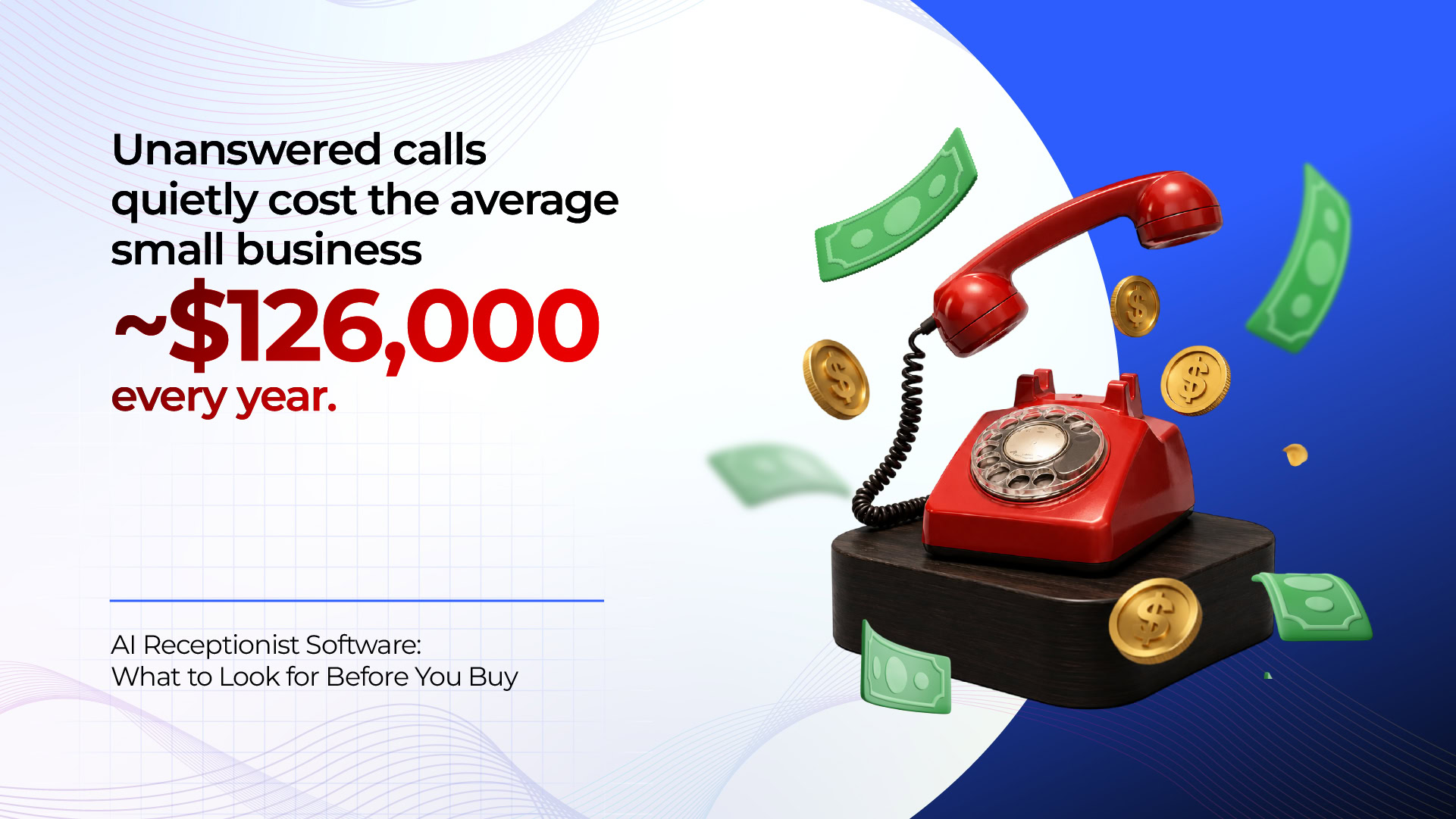
Missed call, missed opportunity. It could be a patient trying to book an appointment, a homeowner with an emergency HVAC repair, or a potential client calling a law firm for the first time, and the way that call is handled often makes the difference between winning the customer or losing them to a competitor. That’s exactly why AI receptionist software has gone from being a novelty to a serious business tool in just a few short years.
But “AI receptionist” has become a bit of a catch-all term, and not all the tools sold under that label do the same job or do it well. Before you buy an AI phone receptionist for your business, it’s worth understanding what the software does, why it matters, and what separates a truly useful system from a glorified voicemail with a chatbot attached.
What is AI Receptionist Software? How Does It Work?
AI receptionist software is a voice based (and often chat based) system that uses conversational AI to answer incoming calls, understand what the caller needs and respond in real time, without a human on the other end. The traditional auto attendant makes the caller navigate a maze of “press 1 for sales, press 2 for support” before reaching a human. An AI virtual receptionist converses naturally, understands intent, and behaves much like a trained front desk employee.
Most AI receptionist systems pack a few key technologies in there:
● Real time voice recognition for converting caller’s voice to text
● Natural language understanding, to understand what the caller is after, even if they use unexpected language
● Your hours, services, pricing and policies in a knowledge or business logic layer
● Create text to speech response in a natural sounding voice
●Integrations that connect the conversation to your calendar, CRM or scheduling system so the AI can do things, not just talk
That means a system that can answer calls, qualify leads, book appointments, answer FAQs, and direct urgent calls to a person without the caller ever feeling like they’re in a phone tree, and that can happen 24/7.
The Benefits of an AI Receptionist for Your Business
Lost revenue, staffing costs and consistency usually boil down to three things for the case of an AI receptionist.
Consistent research on business phone behaviour reveals that a significant percentage of inbound calls to small and mid-sized businesses are left unanswered, particularly outside of business hours or during peak times. Each of these calls is a prospect that may very well call the next business on the list. An AI receptionist fills that gap by ensuring every call is answered every time.
Then there’s the cost equation. Hiring a full-time receptionist, or a team to cover extended hours, is expensive when you consider salary, benefits, training and turnover. An AI receptionist service can handle a much higher volume of calls at a fraction of the cost, and it never calls in sick, takes a lunch break or needs a raise to keep it motivated.
And finally: consistency. A well-implemented AI receptionist will give the same correct answer to a price question every time, will follow the same script for booking an appointment, and will never have an off day that affects how a caller is treated. And that reliability is important for companies that live and die by first impressions.
What to Look for in an AI Receptionist Software?
Not all AI receptionist software on the market is created equal and the differences become apparent quickly when you start relying on the tool in production. Things to consider before you go for it:
Quality of conversation. Request a live demo and speak to the system how a real customer would, interrupt it, ask an off-script question, change your mind mid-sentence. A good AI receptionist tool handles these naturally; a weak one breaks down or defaults to generic responses.
Time for setup & customization. Some platforms need weeks of configuration and scripting before they can take a single call. You can teach others your business information, tone and workflows within days.
Results of Calls and Ownership of Data. You should be able to see call transcripts, call recordings, analytics, not just a black box that says, “call handled.”
Scalability. As your call volume increases, the system should be able to scale without you having to rebuild your system from scratch or pay significantly more per call.
Human handover. Even the best AI receptionist system needs to understand its limitations and know when to transfer complex, sensitive or high value calls to a human being.
What Should an AI Virtual Receptionist Be Capable of?
At the very least, a modern AI virtual receptionist should offer:
● 24/7 call answering – no call goes to voicemail, no matter the time zone or business hours
• Real time calendar sync appointment scheduling, not just a promise to “follow up”
● Qualify leads with the right questions to determine if a caller is a good fit before handing off
● Call routing and transfers so urgent or high-priority calls connect immediately to a human
● Integrations with CRM and business tools, so every conversation automatically updates your existing systems
● Multi language support if your customer base is not just English speaking
● In-depth analytics and call transcripts so you can review performance and spot trends
● Custom voice and brand tone, so the AI sounds like an extension of your business, not a generic chatbot
If a platform is missing several of these, it’s worth asking why, and whether it’s really built for the way your business operates.
Solutions like Olivia AI are tailored for this broader feature set, viewing the receptionist not just as a call answering tool, but as part of a larger inbound strategy.
That approach is part of a broader trend toward AI sales agents that do more than answer the phone. To get an idea of how this fits into a full pipeline, it’s useful to look at Olivia AI, Pete & Gabi’s AI sales agent, which is based on this very idea.
What Questions Should You Ask Before Buying an AI Receptionist Software?
Before you sign a contract, it’s worth getting direct answers to a handful of questions:
● How is the AI trained on our specific business, services, pricing, policies and the time it takes?
● What if the AI does not have the answer to a question? Does it take a guess, or does it fail gracefully?
● Can we see the actual call transcripts and recordings, rather than just summary metrics?
● What integrations are there out of the box and what needs to be custom developed?
● How are you charged – by call, by minute, flat monthly rate or volume tiers?
● What does onboarding mean, and who owns that process?
● Can the system be updated quickly if our hours, pricing or services change?
If a vendor can’t answer these questions clearly, or if he or she dodges questions about limitations, that’s a red flag.
Mistakes to Avoid When Selecting an AI Receptionist Tool
The buying process can trip up even businesses that know an AI receptionist is valuable. The most common mistakes are:
● Select based only on price, without testing actual call quality
● Assumes “set it and forget it”: The best results come from platforms that allow you to iterate on scripts and responses over time
● Not considering integration needs, only to find the AI is unable to book into the calendar or CRM your team already uses
● Not testing edge cases like angry callers, background noise, or strange accents before going live
● Neglect of the human handoff experience which can frustrate callers if poorly executed
● Not involving the team who will use it, leading to poor adoption even after purchase of the software
Avoiding these mistakes usually comes down to slowing down during evaluation and stress testing the system the way real customers will use it.
What Types of Industries Can Benefit from an AI Receptionist?
The technology is the same, but how you set up an AI receptionist will depend on the business.
AI receptionists are usually cheap and easy for small businesses to use. They can answer general questions, take messages and book simple appointments, without needing an IT person to maintain them.
AI receptionists for healthcare settings, and AI receptionists for a medical office need to be careful with scheduling appointments, answering insurance questions and using basic triage language, often with close attention to compliance and patient privacy in some cases.
The AI receptionist is busy in the dental office with appointment booking, reminder calls and answering common questions about procedures or insurance coverage.
AI receptionists are often used by law firms to screen potential clients before they speak to a lawyer, noting down case details and urgency levels so the right person can follow up quickly.
Salons mostly employ AI receptionists to schedule appointments, reschedule appointments and provide information about services and prices when walk-in hours are busy, and staff can’t answer phone calls.
For example, an AI receptionist for HVAC companies is usually set up to do emergency triage, such as tell a regular maintenance call from a no-heat emergency that needs to be dispatched right away.
Typically, an AI receptionist would take care of reservations, questions about hours, the menu, etc. in a restaurant, especially during busy dinner rushes when the staff is busy on the floor.
Many AI receptionists for property managers are available 24/7 to answer leasing questions, screen potential tenants, and take maintenance requests.
Almost all of them have a common thread. The AI receptionist doesn’t just answer the phone, it proactively turns inbound calls into qualified leads.
That’s important because the companies getting the most value out of these tools understand the receptionist as the first step in the sales process, not just an avoidance of voicemail.
Cost of an AI Receptionist service
The cost of AI receptionist services can vary widely depending on call volume, feature set, and the complexity of integrations. Some providers bill a flat amount each month for a certain number of minutes or calls, and charge for anything over that. [Other charge per call or per minute (can be cheaper for low volume businesses, but less predictable at scale). Entry-level call answering tools are typically less expensive than more advanced systems that offer lead qualification, CRM integrations and custom scripting.
It’s good to think beyond the price tag when thinking costs, and to identify the cost-per-call-answered versus the cost of a missed call, including the lifetime value of a customer potentially lost to voicemail. For many companies, once you factor in the recovery of missed calls, a mid-tier AI receptionist plan pays for itself quickly. At the end of the day, the math tends to favor AI receptionists for answering inbound sales calls and not missing a lead, despite the higher upfront cost.
Questions & Answers
Q. Could an AI receptionist handle phone calls like humans?
Modern AI receptionists use natural sounding voices and conversational AI to have a real dialog, understand context and react accordingly, just like a trained human receptionist would. For most common calls.
Q. Can AI receptionist make appointment and booking?
Yes. Most AI receptionist platforms integrate seamlessly with business calendars, allowing callers to make, change or cancel appointments in real-time while they’re on the phone.
Q. Can an AI receptionist answer customer questions and route calls?
Yes, the AI receptionist can answer customer questions and route calls.
Q. Can an AI receptionist integrate with your CRM and business tools?
Yes, an AI receptionist can be integrated with your CRM and business tools.
Most AI receptionist services today will integrate with popular CRMs, calendars and scheduling platforms, so call data flows automatically into your existing workflow, rather than having to be entered manually.
Q. Can AI Receptionist Systems Beat Traditional Virtual Receptionists?
The specific figure varies per business, but common benefits of AI receptionists include 24/7 availability, lower cost per call, and the possibility for instant scalability that human-staffed traditional virtual receptionist services may not be capable of, especially outside of business hours.
The Front Desk: Modern Age Adaptations
The receptionist is not dead but evolving from its traditional role. The next evolution is AI receptionist software. It’s a system that’s always awake, never misses a call, and gets smarter with every conversation it has. If you’re a business shopping around, don’t just look for the cheapest tool out there, look for the one that really gets your business and treats every caller as a real opportunity.
That’s the premise of Olivia AI, an AI receptionist tool built to answer, qualify and book calls 24/7 as a natural extension of your team.
If you’re wondering what a contemporary AI receptionist can do for your company, go ahead and compare Olivia to the top AI sales automation software available today.