A missed call or wrong call to a customer has the same meaning. Modern-day business is increasingly getting rid of outdated forms of Interactive Voice Response (IVR), like “Press 1 for sales” and “Press 2 for support!” Customers look for quick, human interaction which gives them direct accessibility to the right person without going through numerous phone menus.
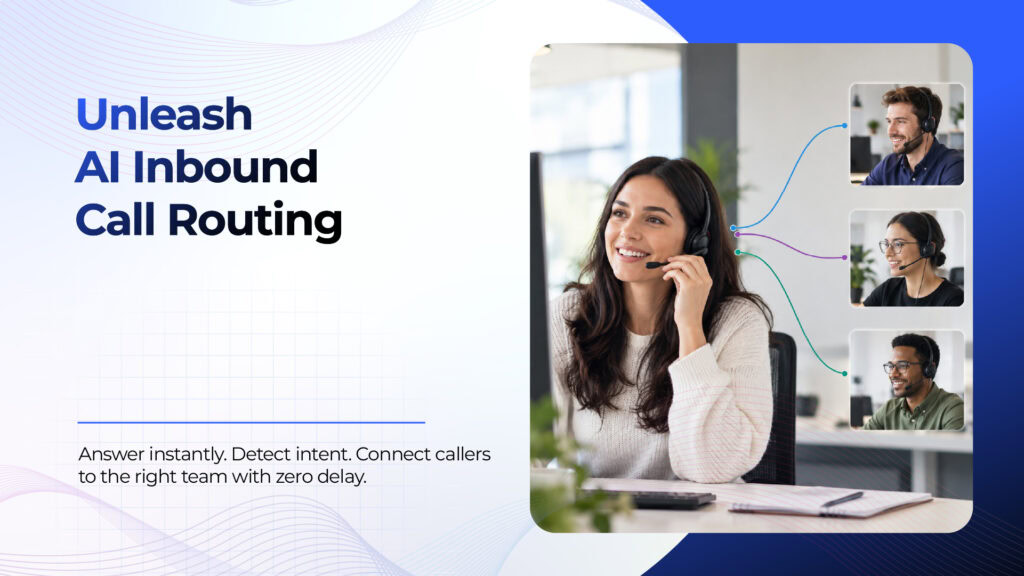
To meet demanding customers’ needs, many businesses are employing new technology to automate inbound calls by means of conversational artificial intelligence. With the technology of using AI voice agent for inbound calls, companies can handle a high number of calls at once and ensure automated call transfer in their products.
This guide describes the process of how efficient call routing works and how AI customer support agents change the strategy to route customer calls to the right department effortlessly.
The Evolution of Inbound Call Handling
For many years, inbound telephone channels depended on either manual receptionists or rigid IVR (Interactive Voice Response) systems, both meant to control the flow of calls, but marking significant obstacles on the way to a pleasant customer journey:
- Prolonged Waiting Periods: With high volume of calls, callers are waiting for their turn for a long time. Hence, they abandon their calls.
- Wrongly Redirected Calls: Incorrect call routing can force customers to repeat information, create frustration, and a poor customer experience.
- Limited Hours of Operations: Conventional call centers usually work only during certain hours.
- Very High Operational Costs: It is rather costly and difficult to build the call-center systems that correspond to all the trends on the market.
The use of inbound sales call automation helps to overcome the operational hurdles by eliminating the limitations of rigid phone trees with the use of conversational and natural voice technology.
How AI-Powered Call Routing Works
New-age AI call-routing software have taken the technology beyond simple voice-recognition technology as they make use of NLP and contextual speech technology for understanding caller intentions and analyzing their tone while communicating.
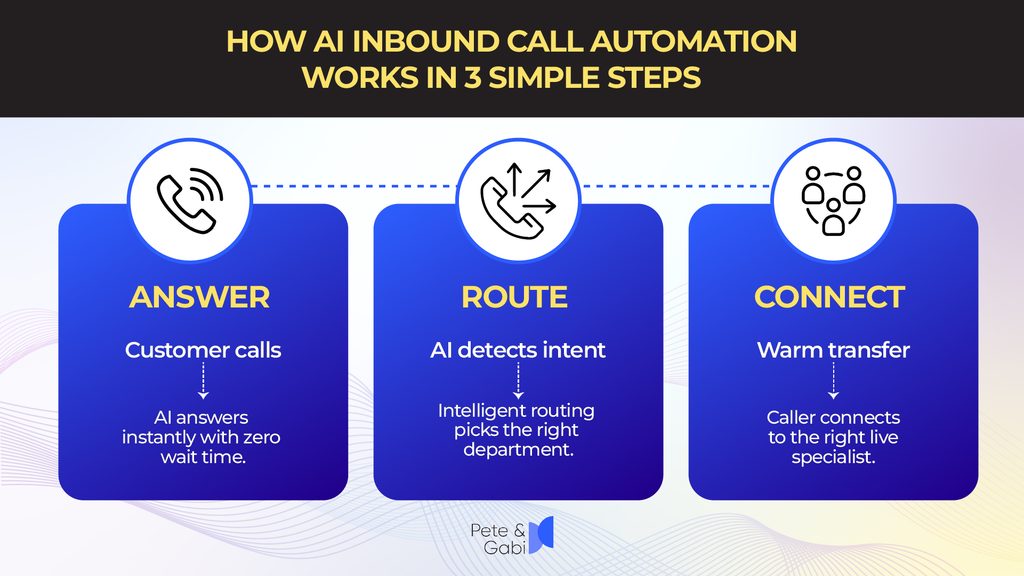
Infographic:
How AI Inbound Call Automation Works in 3 Simple Steps
Key Components of Intelligent Call Dispatch
- Conversational Intake: An AI phone answering service talks to people in an easy manner by asking them questions like “How can I assist you today?” It allows customers to specify their preferences rather than choose only from predefined options.
- Intent Recognition: The system evaluates the communication of the caller to determine whether the caller is seeking assistance in technical, billing, or sales.
- Contextual Routing: The AI makes use of intelligent call routing by reviewing the caller’s previous interactions and summarizing their intent.
- Warm Transfers: While executing the automated call transfer, the AI shares the caller’s issue details with the next agent.
Olivia: The Next Generation AI Agent
The shift toward intelligent conversational intake is being guided by Olivia, an advanced AI voice agent which has been developed by Pete & Gabi. Olivia AI signifies a huge progress from the standard auto attendants by providing dynamic and human-like conversation enabling it to carry out conversation with callers and respond to inquiries and leads qualification.
- Natural flow of conversation style: Olivia AI has a human-like manner of speaking whereby she has a dynamic way of talking instead of following a script.
- 24/7 availability: Olivia AI will make sure that your call lines are answered whenever a potential customer calls.
- Speedy lead qualification: Olivia AI uses tailored questions that help her identify if a certain call is from a quality lead based on one’s Ideal Customer Profile (ICP).
- Integration with CRM: Olivia AI is easy to use as it can be plugged into any enterprises like Salesforce and HubSpot and be able to make updates in the call logs automatically.
Organizations using Olivia AI get access to advanced AI call routing that enhances effectiveness and customer service.
Step-by-Step Guide: Automating Your Inbound Call Operations
Changing your current communication system into automated and intelligent technology necessitates following a defined path.
Step 1: Assess Incoming Calls Patterns
Before putting any program into practice, analyze the telephone history of incoming calls.
- What are 5 possible reasons for customers’ calls?
- What are departments with the biggest number of wrongly sent calls?
- What times of the day are the busiest in terms of calls received and the average number of abandoned calls?
Recognizing these patterns will help you train your system to manage frequently asked questions on its own and direct complicated situations smoothly.
Step 2: Implement Conversational AI Call Routing Software
Choose a strong platform that has modern automated call routing features. Find solutions that integrate smoothly with your existing Voice over Internet Protocol and Customer Relation Management solutions.
The program you select should have features for fast decision-making, language processing, and passing live calls.
Step 3: Configure Routing Logic and Department Rules
It is essential to create fixed rules for how incoming calls get transferred:
Skill-based Routing: Match incoming callers with agents who are qualified to provide solutions.
Priority Routing: Connect important customers or critical calls to their personal representatives immediately.
Time-based Routing: Route calls made at odd hours to emergency services or to an automated hours service.
Once you have put the rules in place, your service will be an effective automatic call forwarding tool that will allow your staff to work in a proper way without any calls getting dropped.
Step 4: Train Your AI Agent for Brand Alignment
Train your AI Voice Agents for Lead Qualification (e.g., Olivia AI) on your company’s communication strategy, standard operating procedures, and product literature, so it can immediately provide standardized answers to the most frequently asked questions and know when to direct a client to the relevant agent.
Comparing Traditional IVR vs. AI Call Routing
To assess the operational return on investment for upgrading your system, you must analyze the main functional distinctions:
| Feature | Traditional IVR | AI-Powered Call Routing |
| Caller Interaction | Rigid keypad presses | Natural, fluid conversation |
| Setup & Flexibility | Complex menu trees, difficult to edit | Adaptive learning, easy workflow updates |
| Intent Understanding | Low (limited to predefined options) | High (understands context and intent) |
| Routing Precision | Frequent misdirection | High accuracy based on live data |
| First-Contact Resolution | Low to Moderate | High (resolves simple queries automatically) |
Best Practices for Seamless Live Agent Transfers
Even if the process of automating incoming inquiries is time efficient, something needs to be done by humans in a complicated situation. To ensure a good customer experience during transfers:
- Provide Full Context: The incoming employee must receive a record of what the AI manager has said before he speaks to the customer.
- Cut Down Waiting Periods: In a situation where all the employees are busy, it is advisable to let the AI manager suggest another time for the call instead of torturing the customer.
- Use Friendly Tone: The handoff from the AI should be produced in a way that will make the customer feel taken care of rather than just put in a queue.
Measuring Success: Key Metrics to Track
After launching your inbound automation, you should monitor these important indicators of success:
- First call resolution: Rate at which incoming calls are closed without further follow-up.
- Average handling time: Decline the time spent on phone calls because of the faster intake.
- Call Containment Rate: Percentage of calls handled directly by AI with no intervention from live agents.
- Customer Satisfaction Score: Data collected from clients after the call.
Unleash Seamless Inbound Call Routing Today
There was a time when automating incoming calls was simply a way to save costs. Yet, modern businesses now must take fast, intelligent customer experience to a new level. AI call routing software and smart virtual agents such as Olivia AI allow organizations to handle large numbers of phone calls, obtain qualified leads round-the-clock.
While making investments into contemporary voice automation helps to get rid of waiting times and increase efficiency of operations, it guarantees all callers receive immediate assistance consistently route customer calls to the right department.
FAQ
1. What factors are considered in intelligent call routing for modern contact centers?
Intelligent call routing is not just traditional phone trees; it can go much further than simply displaying caller ID. It assesses customer intentions by applying Natural Language Processing as well as analyzing customer data from customer relations management (CRM) system. Intelligent call routing takes into consideration the customer’s history and account level along with the availability of agents and their skills. It allows resolving issues effectively on the first attempt and significantly reducing customer waiting time.
2. How can small businesses cost-effectively route customer calls to the right department without complex hardware?
Cloud-based artificial intelligence solutions enable companies to route calls of customers straight to the department they need without having to pay for expensive traditional in-house PBX hardware. By making use of a virtual phone number and AI agent Olivia by Pete & Gabi, small businesses have the opportunity to use sophisticated IVR technology with a great number of calls being conducted simultaneously.
3. What are the key performance metrics positively impacted by successful automated call transfer integration?
Using an effective call transfer system positively influences important benchmarks of a contact center such as First Contact Resolution (FCR) and Average Handle Time (AHT). As customers do not have to wait for the call to be transferred to the right department, there are more chances that they will be satisfied with the service provided.
4. When is an AI phone answering service superior to a traditional live operator model?
Using an AI-powered phone answering service is a smart move when companies need help with large numbers of calls, late night requests, or sudden rise in call volume. Since live agents are restricted by working hours, tiredness and answering one call at the time, on the other hand, AI callers are capable of working any number of hours, assisting without waiting and ensuring same high quality of performance for almost no money at all.
5. Does inbound call automation replace human agents entirely, and how should it be structured?
Call automation is intended not for the replacement of live call agents but rather for the assistance of human employees engaged in repetitive and routine work. The optimal model uses conversational AI as the first line of defense welcoming customers, obtaining necessary data, making routine checks, and transferring complex calls to live agents.