When a company has to hire hundreds of retail associates, healthcare workers or customer support representatives under tight deadlines, standard recruiting tools quickly break down.
The sheer volume of applications (thousands a week) creates an administrative nightmare for recruiting teams. Recruiters spend dozens of hours combing through resumes and manually scheduling phone screens, while top applicants wait days for a response. In high-volume recruiting, slow communication can be a direct cause of ghosting, application drops, and employer brand reputation damage.
To build an effective high-volume hiring process, you need to balance speed and empathy. By automating the recruitment workflow, talent acquisition teams can shorten the time it takes to screen candidates initially, eliminate delays caused by coordinating calendars, and maintain clear communication with candidates throughout each stage of the funnel.
This guide outlines the process to implement hiring process automation while ensuring every applicant a transparent, respectful and engaging candidate experience.
What makes high-volume hiring different (and harder) than standard recruiting?
The difference between high-volume hiring and traditional recruiting is that high-volume hiring is more about speed, the number of candidates that go through the pipeline, and keeping candidates from dropping out, whereas traditional recruiting is more about finding the perfect executive candidate.
Professional or executive recruiting is about filling one specialized position out of ten applicants. High-volume recruiting is about sifting through hundreds or thousands of inbound applications to fill dozens of open headcount demands at the same time.
According to Indeed’s Guide to High-Volume Hiring, high-capacity recruitment surges introduce unique operational challenges:
- Extreme Application Density: Popular entry-level, healthcare, retail or hospitality postings often draw 500+ applications per open role.
- High Candidate Churn & Competition: Frontline and entry level talent are applying to many jobs at a time. Should a hiring team take longer than 48 hours to respond, candidates are moved to other offers.
- Recruiter Burnout: Manual tasks such as reviewing resumes, calling applicants and leaving voicemails consume up to 80% of a recruiter’s work week.
- Brand Reputation Risk: Rejecting or ignoring hundreds of candidates without providing clear feedback can lead to negative public reviews and damage customer loyalty.
What does a high-volume hiring workflow look like, step by step?
A high-volume hiring process moves job seekers through five progressive pipeline stages: application, screening, interviewing, scheduling, and offer management.
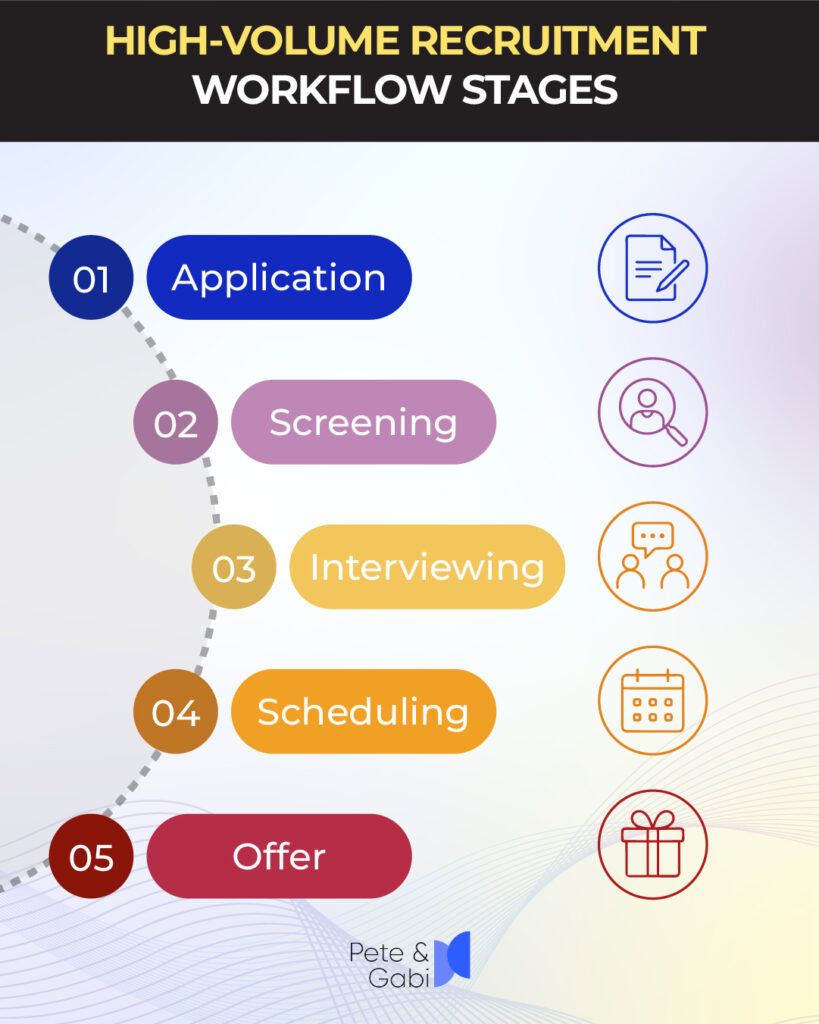
To keep pipeline velocity high across large applicant pools, each step must flow smoothly into the next:
- Seamless Application Capture: Candidates search for jobs on career sites or job boards and submit basic contact details and qualifications via mobile-friendly forms.
- Instant Candidate Screening: Rapid qualification checks to confirm work authorization, location requirements, shift availability, and core competency fit.
- Interactive Candidate Assessment: Qualified candidates are evaluated through interactive skills assessments or initial conversational assessments.
- Automated Interview Scheduling: Top-scoring candidates pick available live panel or manager interview times from open calendar slots.
- Offer Extension & Onboarding: Pre-screened candidates are provided with digital offer letters, links to background checks and onboarding documentation
Where do most high-volume pipelines break down (screening bottlenecks, scheduling, ghosting)?
High-volume pipelines break down primarily at three major operational friction points: manual resume screening, calendar scheduling delays, and long communication silences.
When hiring teams rely on manual administrative processes to handle hundreds of applicants, bottlenecks form rapidly across the candidate journey:
| Pipeline Breakdown Area | Root Cause of the Bottleneck | Direct Impact on Candidates & Hiring Goals |
| Screening Backlogs | Recruiters manually review hundreds of PDF resumes line-by-line in the ATS. | Top talent sits unreviewed for days, leading 70% of candidates to disengage. |
| Calendar Scheduling Tag | Recruiters send back-and-forth emails to align candidate and manager availability. | The scheduling phase takes 2 to 4 days per candidate, swelling total time-to-hire. |
| Communication Ghosting | Busy recruiting teams lack time to send status updates to non-selected applicants. | Rejected candidates feel ignored, publishing poor reviews on Glassdoor or social media. |
| High Interview No-Show Rates | Unvetted candidates miss scheduled interviews due to lack of reminders or lost interest. | Hiring managers waste valuable working hours waiting in empty virtual call rooms. |
Addressing these pipeline bottlenecks requires replacing manual administrative drag with structured hiring process automation.
How to automate every step without harming candidate experience?
You automate every step of high-volume hiring without sacrificing candidate experience by blending fast automated actions with personalized messaging, instant status updates and clear timeline expectations.
Automation should never be impersonal or inflexible, or not care about job seekers. According to SHRM’s Research on Candidate Feedback, job seekers appreciate automated systems as long as they provide clear updates and respect the applicant’s time.
Here’s how talent teams balance automation speed with a high-touch candidate experience at each stage of the pipeline:
1. Application Stage: Conversational & Mobile First Apply
Long 30-minute applications are being replaced by mobile-optimized conversational forms Candidates completing applications in under 3 minutes via mobile web or messaging platforms have much higher application completion rates.
2. Screening stage: Qualification 24/7 instant
Instead of making applicants wait several days to hear back from a recruiter, put a candidate screening workflow in place that starts engaging candidates the moment they apply. Candidates go through initial screens on evenings/weekends to fit their schedule.
3. Self-Service Calendar Reservation Scheduling Stage
Eliminate email tag around scheduling and instantly send self-service calendar links to candidates that meet initial qualification criteria. Candidates select an available time slot in seconds, and automated SMS and email reminders help reduce interview no-show rates.
4. Communication & Feedback Phase: Automated Rejection Handling
Never leave applicants in the dark. Send polite, automated updates to candidates who aren’t selected, explaining their next steps, or invite them to join your talent community for future openings.
Where does AI fit naturally into the process not as a bolt-on tool, but as a step?
AI is a natural fit for high-volume hiring, not as some external “bolt-on” add-on, but as an embedded operational step in the core screening and scheduling workflow.
Smarter AI removes the need for recruiters to log into multiple point solutions by serving as a digital team member that automatically performs tasks within your candidate pipeline.
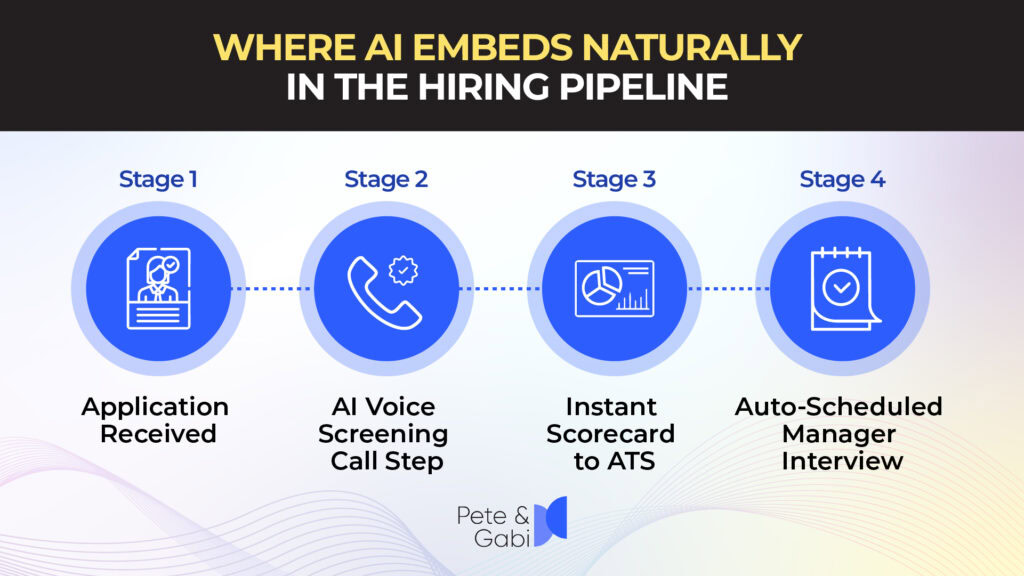
AI tech delivers the most value when it’s applied to perform structured, repetitive tasks at scale, as outlined in SHRM’s Analysis on AI in Recruitment:
- Conversational Voice Screening: Immediately after application submission, an interactive AI agent makes screening calls. The agent engages in natural two-way voice conversations, vets qualifications, probes candidate skills and answers role-specific questions 24/7.
- Objective Competency Scoring Immediately after post-screen, the AI creates an objective scorecard measuring candidate skills against standardized rubrics and uploads transcripts directly into your ATS.
- Real-Time Fraud & Identity Verification AI screening engines act like a security firewall, identifying deepfake audio or synthetic candidate profiles before hiring managers invest their time in live panel interviews.
In niches such as clinical operations, healthcare, or staffing agencies, high candidate volume is likely to lead to staff burnout. Learn how to do high-capacity recruitment in your industry with our guide to how to handle high-volume hiring in healthcare without burning out your recruiters.
How do you measure success after automating high-volume hiring?
You measure success after automating high-volume hiring by tracking four core Key Performance Indicators (KPIs): time-to-hire, candidate completion rate, recruiter bandwidth capacity, and candidate satisfaction scores.
Implementing high-volume candidate screening and workflow automation should deliver immediate, quantifiable improvements across your talent acquisition operations:
| Success Metric / KPI | What It Measures | Target Outcome Post-Automation |
| Time-to-Hire / Time-to-Fill | Total days from candidate application to accepted job offer. | Reduced by 50% to 70% (compressing screening from weeks to 24–48 hours). |
| Screening Completion Rate | Percentage of applicants who finish preliminary screening assessments. | Increased to 85%+ due to mobile accessibility and 24/7 availability. |
| Interview Attendance Rate | Percentage of candidates who show up for live manager interviews. | Increased by 35% through instant self-scheduling and automated SMS reminders. |
| Candidate CSAT / NPS | Candidate feedback score on application clarity, speed, and communication. | Substantially higher scores due to zero ghosting and instant status updates. |
See Where Rebecca AI Fits Into Your Hiring Process
To meet high-volume hiring needs, there’s a need to move away from manual resume screening and slow scheduling cycles.
Rebecca AI Recruiter fits into your existing talent acquisition infrastructure effortlessly, adding an intelligent screening stage to your process that interacts with candidates 24/7, verifying key skills and delivering structured shortlists straight to your ATS.
Whether you’re handling internal corporate recruiting or creating placement pipelines for staffing agencies, today’s automation can screen thousands of candidates without adding headcount or sacrificing candidate care.