
Talent acquisition professionals are experiencing an unprecedented capacity crunch. The volume of applications for each open position has exploded, but hiring teams are still expected to maintain high standards of candidate quality without increasing their internal headcount.
The quality suffers when recruiters spend most of their week on repetitive administrative tasks. The best candidates disconnect from the hiring process, the hiring managers get frustrated with late shortlists and the burnout rates increase among recruiters.
Increasing recruiter productivity does not mean asking your team to work faster or cut corners when evaluating candidates. It is not about that. It is about re-thinking the structure of hiring workflow, removing administrative friction and letting modern digital tools take care of the repetitive logistics.
This hands-on guide reveals where recruiter time is lost, why traditional tech stacks don’t help with the workload, and what high-performing talent teams do differently to get those hours back.

What does a recruiter’s day actually look like across sourcing, screening, scheduling, and admin work?
Talent leaders need to dig into how recruiters spend their time to understand why hiring throughput stalls. You won’t often find a typical recruiter spending their week building relationships or coaching hiring leads. Instead it is consumed by piece-meal administrative work across many systems.
![WHERE RECRUITERS SPEND THEIR TIME [Manual Admin & Data Entry: 35%] ➔ [Scheduling & Email Tag: 25%] ➔ [Sourcing & Screening: 20%] ➔ [Candidate Engagement: 20%]](https://www.petegabi.com/wp-content/uploads/2026/07/12-info-2-1-819x1024.webp)
The four primary areas of operation for a talent acquisition professional in a typical day are:
- Sourcing & Candidate Discovery: Reviewing inbound applications, searching talent databases and passive candidate outreach.
- Initial candidate screening: Reading resumes line-by-line and asking the same 15-minute qualifier questions over and over again in dozens of introductory phone calls.
- Interview Scheduling Logistics: Interviewer availability, candidate invitations, time zone conversion, last-minute calendar changes.
- Administrative Documentation: Transcribing interview notes, updating ATS pipeline stages, writing feedback emails and generating progress reports for leadership.
Recruiters spend more than 60% of their time on administrative work, leaving the real high-value activities (e.g., deep candidate relationship development and strategic workforce planning) on the back burner.
Why does recruiter workload keep growing even as teams add more tools?
Many organizations spend heavily on recruitment tech stacks and still see hiring velocity slow down and recruiter workload increase.
SHRM’s Workplace Trends Report says that adding software tools without simplifying the underlying workflows leads to digital fatigue. Disconnected applications create data silos instead of simplifying work. Recruiters spend hours toggling between ATS databases, dashboards of job boards, calendar tools, and email inboxes, copying data from one screen to the next, manually.
Moreover, easy-apply job portals enable candidates to submit resumes instantly, leading to an influx of applications in recruiters’ inboxes. Without an automated way to work through top of funnel applications, recruiters are buried under piles of resumes, turning their day-to-day work into reactive triage instead of proactive hiring.
What are the most common productivity drains for recruiters?
The efficiency of recruiters rarely fails due to lack of effort, it fails due to systemic friction that is built into daily operations.
Ashby’s Recruiter Productivity Trends Report shows that teams lose three major operational bottlenecks of capacity every week:
1. Persistent Context Switching
Distributing the recruiter’s focus across resume screening, live phone calls, calendar management, and inbox handling. Studies have shown that it takes more than 20 minutes to refocus after a minor interruption, drastically stealing away time from your daily productivity.
2. Manual Candidate Follow Up Friction
Hours of manual work to reach out to candidates, send status updates and check in with non-responsive applicants. Without automation, follow-ups are delayed, causing applicants to disengage or accept competing offers.
3. Calendar Scheduling Tag
Scheduling a time that works for candidates and busy hiring managers is a huge time suck. The back-and-forth of multiple emails to confirm a single 30-minute interview extends hiring timelines and bloats time-to-fill metrics.
What separates high-performing recruiting teams from overloaded ones?
High-performing talent acquisition teams do not work longer hours; they structure their operations to minimize friction and protect recruiter bandwidth.
| Operational Dimension | Overloaded Recruiting Teams | High-Performing Recruiting Teams |
| Daily Workflow Focus | Reactive triage; spending hours reading resumes and typing notes. | Proactive strategy; focusing energy on high-value candidate conversations. |
| Follow-Up Management | Manual outreach emails leading to delayed candidate communication. | Automated follow-up workflows ensuring zero candidate drop-off. |
| Calendar Coordination | Back-and-forth emails proposing open time slots across teams. | Self-service candidate booking synced directly to manager calendars. |
| Screening Execution | Conducting 20+ repetitive introductory phone calls every week. | Delegating preliminary qualification to standardized screening steps. |
Instead of relying on manual coordination, high-performing teams leverage structured processes to minimize administrative drag, increase candidate engagement, and keep hiring timelines on track.
What practical changes actually give recruiters time back?
To free up recruiter capacity, you need a mix of process optimization, smart delegation and targeted automation. To help talent teams get to work efficiently without sacrificing candidate experience, make these five practical adjustments:
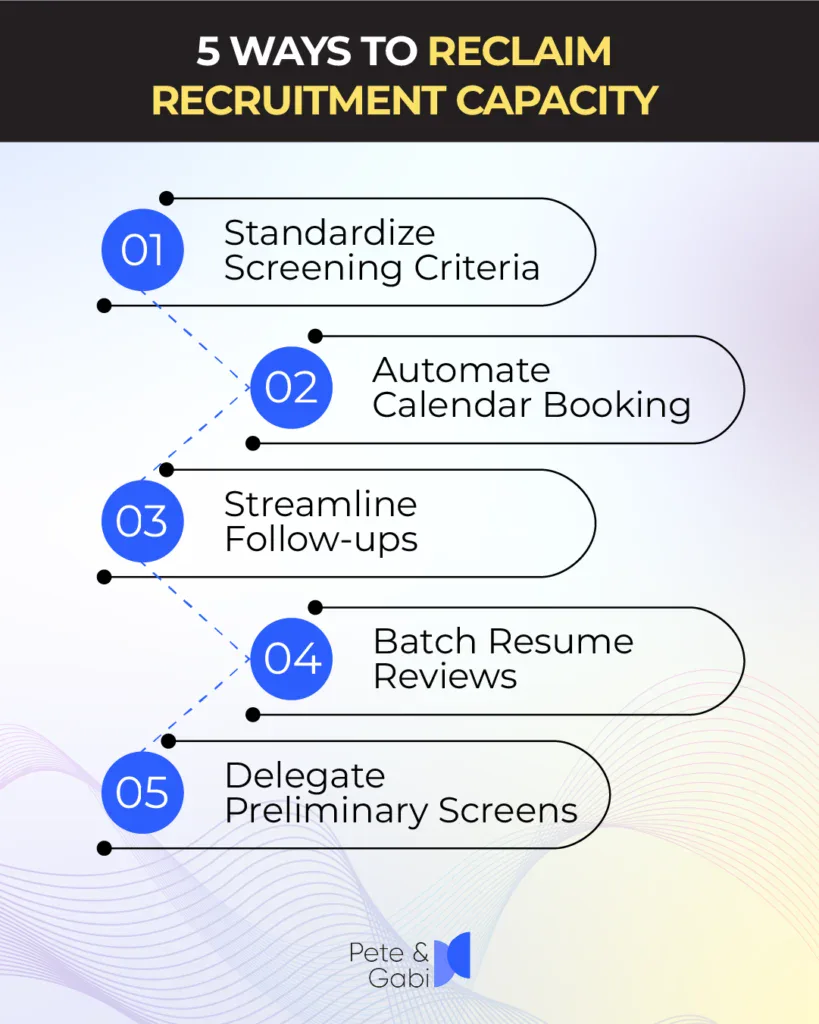
- Standardize Candidate Evaluation: Establish objective rubrics and standardized question sets for every job requisition before posting, eliminating guesswork during resume reviews.
- Implement Self-Service Scheduling: Allow qualified candidates to select interview times directly from open team calendar slots, eliminating email chains completely.
- Batch Administrative Tasks: Set dedicated time blocks for reviewing resumes and updating ATS records rather than checking applications sporadically throughout the day.
- Automate Outreach Workflows: Deploy candidate outreach automation tools to send immediate application receipts, interview reminders, and stage updates automatically.
- Delegate Preliminary Screening: Utilize digital screening steps to verify basic qualifications, salary alignment, and technical fit before recruiters hop on live calls. For actionable guidance on setting up structured screening checkpoints, explore our deep dive into the candidate screening process.
By delegating administrative logistics, hiring teams protect their weekly schedule, giving recruiters time back to focus on candidate engagement and quality evaluations.

Getting Back to What Matters Most
To boost recruiter productivity, you need to work smarter, cut out administrative drag and empower talent acquisition teams to do what they do best: connect with people. Streamlining workflows, implementing self-service scheduling and creating structured evaluation frameworks can help organizations scale candidate capacity while improving the overall hiring experience.
With talent acquisition strategies evolving, smart conversational platforms like Rebecca AI Recruiter are helping modern teams protect recruiter bandwidth. AI agents take over top-of-funnel screening calls and candidate follow-up automation, instead of replacing human judgment, allowing recruiters to focus on candidate engagement and strategic decisions. Learn about our complete set of recruiting automation tools and how automated workflows change the day-to-day of hiring.