To fill empty seats and to reduce team burnout, talent acquisition teams and hiring managers often prioritize speed over accuracy. It can be a very tempting thing to just give someone “okay” so you can close the requisition. But it’s a game of mathematical risk to sacrifice candidate quality.
When a new hire lacks the technical skills, cultural fit or basic drive to succeed in their role, the financial and operational consequences are felt throughout the entire organization. The damage is much more than the original recruiter fees or the time spent on-boarding.
If you are a business leader or talent professional looking to optimize your workforce budget, understanding your true risk exposure is a must. This comprehensive guide details what is a mis-hire, exposes the shocking bad hire statistics every executive needs to know, uncovers the hidden iceberg of organizational costs, and offers practical ways to identify poor-fit candidates long before the final offer letter is signed.
What actually counts as a “bad hire”?
In calculating the cost of a bad hire, many organizations make the mistake of considering only spectacular, immediate failures, like an employee who commits gross misconduct or leaves in a fiery exit after three weeks. Indeed, such dramatic departures are rare. Most mis-hires are quiet, chronic underperformers who slowly drain resources.

A “bad hire” is typically a new employee who negatively impacts business operations, team morale or client relationships due to a fundamental mismatch between their abilities and the requirements of the role.
This mismatch typically occurs in one of three ways:
- Capability Gap : Candidate oversold their technical skills in the interview and can not perform the essential functions of the job without continuous, heavy intervention from their manager.
- The Cultural Disruptor: The individual has the right hard skills, but their communication style, lack of accountability or toxic attitude turns top talent away and rots team cohesion.
- The Apathetic Drifter: The employee does just enough to not get fired outright, but they don’t have an ounce of initiative, always miss deadlines, and make other team members pick up the slack. This often results in a quiet firing cycle where managers just stop giving them important work rather than face the conflict head-on.
How much does a bad hire really cost, beyond salary?
Executives often focus only on lost base salary when they ask, “how much does a bad hire cost?” But the average salary is only a fraction of the real financial haemorrage.
The absolute minimum for calculating this mistake, according to the U.S. Department of Labor, is at least 30% of the employee’s earnings in the first year. But that 30% is a very conservative estimate, and only takes into account direct replacement costs.
Throw in lost productivity, management drain and cultural impact and the numbers skyrocket. The Society for Human Resource Management (SHRM) estimates the real monetary impact to be from 50% to upwards of 200% of the employee’s annual salary (depending heavily on their seniority and the technical complexity of the role).
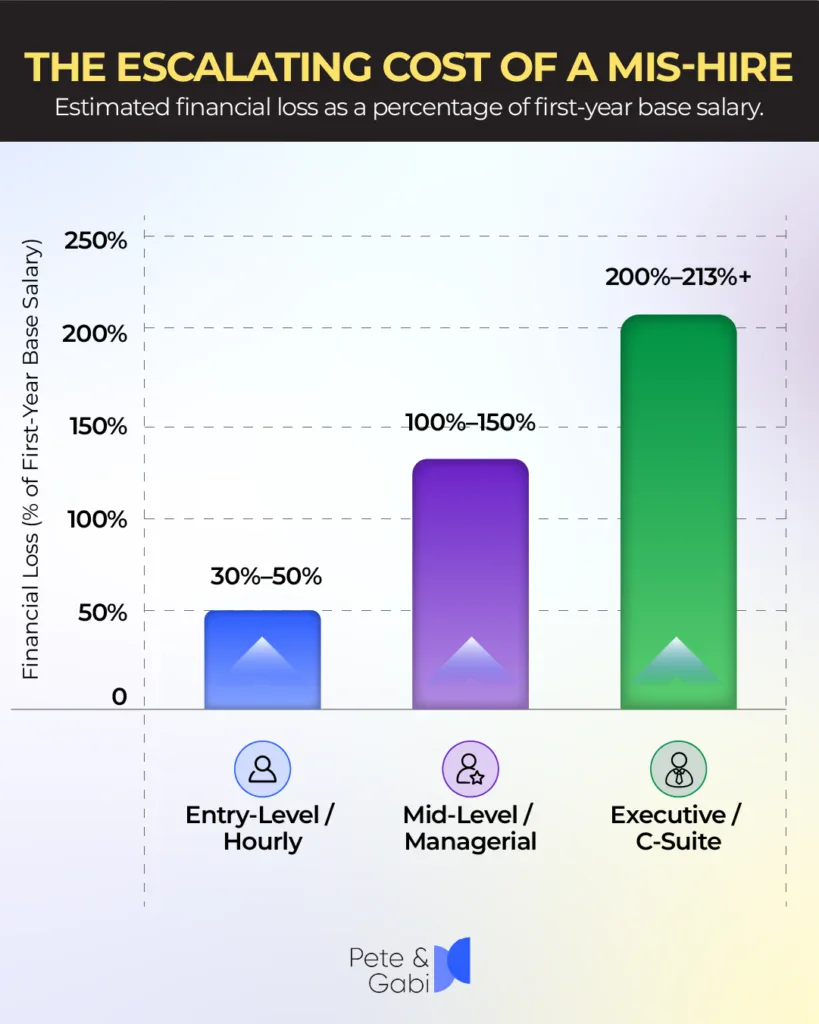
Estimated Financial Loss by Role Seniority
| Role Seniority Level | Expected Financial Loss (Percentage of Base Salary) |
| Entry-Level / Hourly Roles | 30% – 50% |
| Mid-Level Technical / Managerial | 100% – 150% |
| Executive / C-Suite Leadership | 200% – 213%+ |
(Source: Aggregated benchmarks from the U.S. Department of Labor and SHRM Human Capital Benchmarking Reports)
To put these bad hire statistics in perspective, a mistake hiring a mid-level manager who makes $85,000 a year will easily cost your organization more than $100,000 in compounded losses by the time they are identified, terminated and fully replaced. For specialized executive positions, that figure often exceeds $240,000.
What are the hidden costs of a bad hire (team morale, manager time, client relationships)?
To accurately measure your total exposure, you must visualize the financial impact as an iceberg. The initial hiring cost is merely the visible tip above the waterline. The expenses that actually sink corporate budgets lie completely hidden beneath the surface.
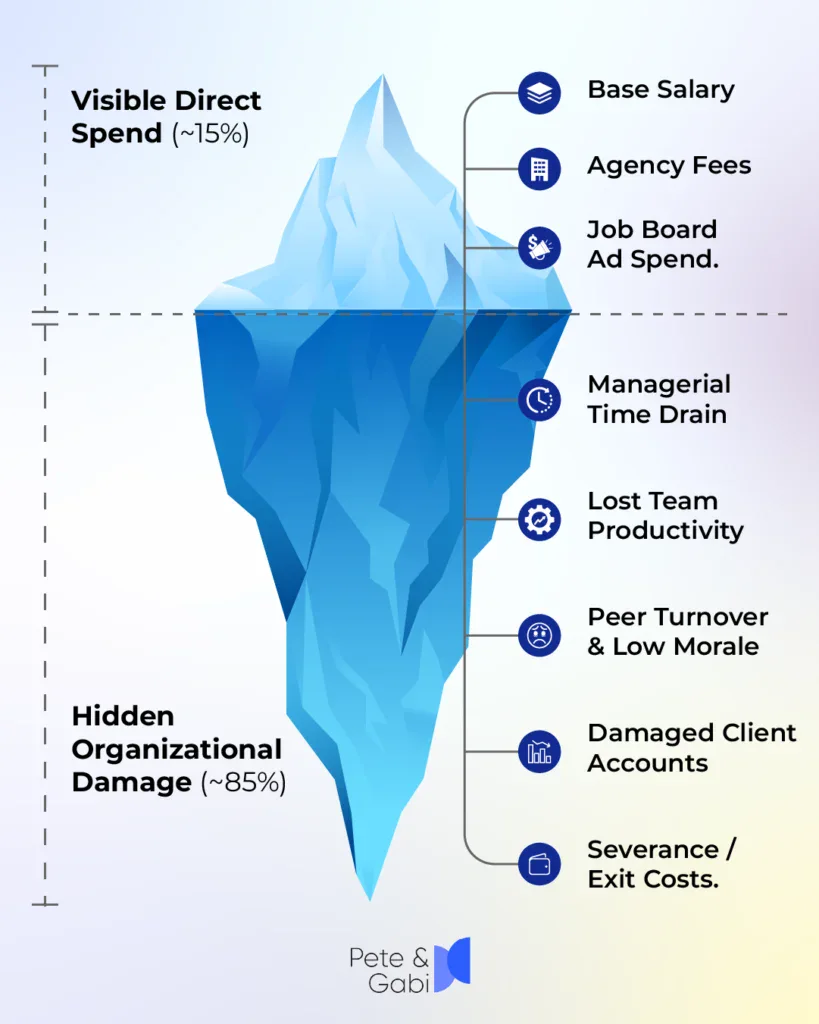
The Iceberg of Organizational Costs
| Visible Direct Costs (The Tip of the Iceberg) | Hidden Indirect Costs (Below the Surface) |
| • Base Salary and Benefits Paid Out | • Lost Team Productivity & Operational Bottlenecks |
| • External Agency Fees & Job Board Advertising | • Decreased Team Morale & Increased Peer Turnover |
| • Background Checks & Pre-Employment Tests | • Massive Drain on Hiring Manager Time |
| • Formal Onboarding Materials & Software Licenses | • Damaged Client Relationships & Lost Revenue |
| • Sign-on Bonuses or Relocation Packages | • Severance Pay and Potential Legal Fees |
Hidden costs are insidious because they don’t show up as a single line item on a budget spreadsheet.
- The Ripple Effect & Lost Productivity: When a staff member isn’t performing, they become a bottleneck in operations. According to a Gallup study, actively disengaged employees cost U.S. companies hundreds of billions of dollars each year in lost productivity.
HBK CPAs and Consultants
- Time Sink: Poor performers require continuous supervision. It’s not unusual for a high salaried engineering or sales manager to spend 15% to 20% of their workweek managing one underperforming direct report. That is really expensive executive time that is being diverted away from strategic growth altogether.
- Cultural decay and peer turnover: High performers hate to be held back by incompetent teammates. A toxic or apathetic hire undermines psychological safety and team trust. When a bad hire causes one of your best veteran employees to walk out in frustration, your total financial loss is essentially doubled overnight.
- Damage to Client Relationships: If the employee who is a misfit deals with customers, their blunders directly tarnish the reputation of your brand. A single bad enterprise account can cost you hundreds of thousands of dollars in lost recurring revenue.
How do bad hires happen, even with a “good” interview process?
The painful realization for talent teams is that a candidate that sailed through a tough four-round interview process still failed on the job. How does this come about?
The reality is that most traditional interview loops are seriously broken because they are ridiculously unstructured. Even if a company believes it has a “good” process, it is usually based on subjective intuition. Interviewers using “gut-feel” approaches tend to give higher scores to charismatic, highly articulate candidates than to actually competent but less extroverted candidates.
Unstructured interviews, in particular, are highly vulnerable to “affinity bias” or the “similar-to-me” effect. The hiring manager might subconsciously have a bias for the candidate because they attended the same university, or they have the same hobby, thinking that cultural fit is technical fit.
Tired, distracted, or anxious to fill a role, human interviewers don’t ask deep, probing follow-up questions. They accept rehearsed, superficial answers at face value. This lack of rigorous validation at the top of the funnel allows chronic underperformers to slip through the cracks and score a final offer.
What can hiring teams do differently to catch bad-fit candidates earlier?
The only way to reduce the massive cost of a bad hire is to fundamentally change the way you evaluate candidates at the very top of your pipeline. You can’t trust a 30 minute chat vibe-check to protect a $100,000 investment.
Organizations need to implement strict best practices for candidate screening to weed out the misfits before they get to your hiring managers.
- Define Objective Competencies: Prior to posting any job opening, the hiring manager should clearly define the specific, measurable hard and soft skills required for success in the position.
- Standardize the Questions: All candidates interviewing for the role must be asked the same baseline questions. You can’t compare Candidate A on Python development with Candidate B on team leadership in an objective manner.
- Need Rubric-Based Scoring: Interviewers are required to score the candidate’s answers based on a pre-determined rigid rubric. We need to specify concrete examples for a “good” answer, and not leave it up to the subjective interpretation of the interviewer.

How does a more consistent, structured interview process lower bad-hire risk?
Industrial-organizational psychology has proven for decades that structured interviews are vastly superior to unstructured conversations when attempting to predict true on-the-job performance.
Structured vs. Unstructured Evaluation Risk
| Evaluation Methodology | The “Gut-Feel” Unstructured Process | The Structured, Same-Rubric Process |
| Skill Validation | Relies heavily on candidate’s self-reported claims. | Tests specific competencies against a rigid scorecard. |
| Bias Susceptibility | High risk of affinity bias and mood-based scoring. | Low risk; decisions are anchored to objective data. |
| Overall Bad-Hire Risk | High probability of expensive mis-hires slipping through. | Dramatically lower risk of post-hire failure. |
The way you make the interview process consistent and structured for every candidate is a way you make the candidates demonstrate their capabilities rather than just talking around them. This is the single best way to catch mis-fits before an offer is made, not three months later.”
If training an entire organization of human hiring managers to follow a structured rubric sounds impossible, modern enterprise teams are solving this exact problem with conversational AI.
Companies can conduct rigorous, fully structured voice interviews automatically with an intelligent execution layer such as Rebecca AI Recruiter. Rebecca asks every applicant the same baseline questions, probes dynamically for technical depth to break through rehearsed answers, and scores every candidate against a completely objective, unshifting rubric.
If you want to optimize your budget even more, check out our guide on how to calculate and reduce your cost per hire to learn how to audit your current cost structure of hiring .
Don’t waste your team’s morale and your company’s budget on gut feel hiring. Sign up for Rebecca AI today to discover how structured conversational evaluation can bulletproof your pipeline for costly mistakes.