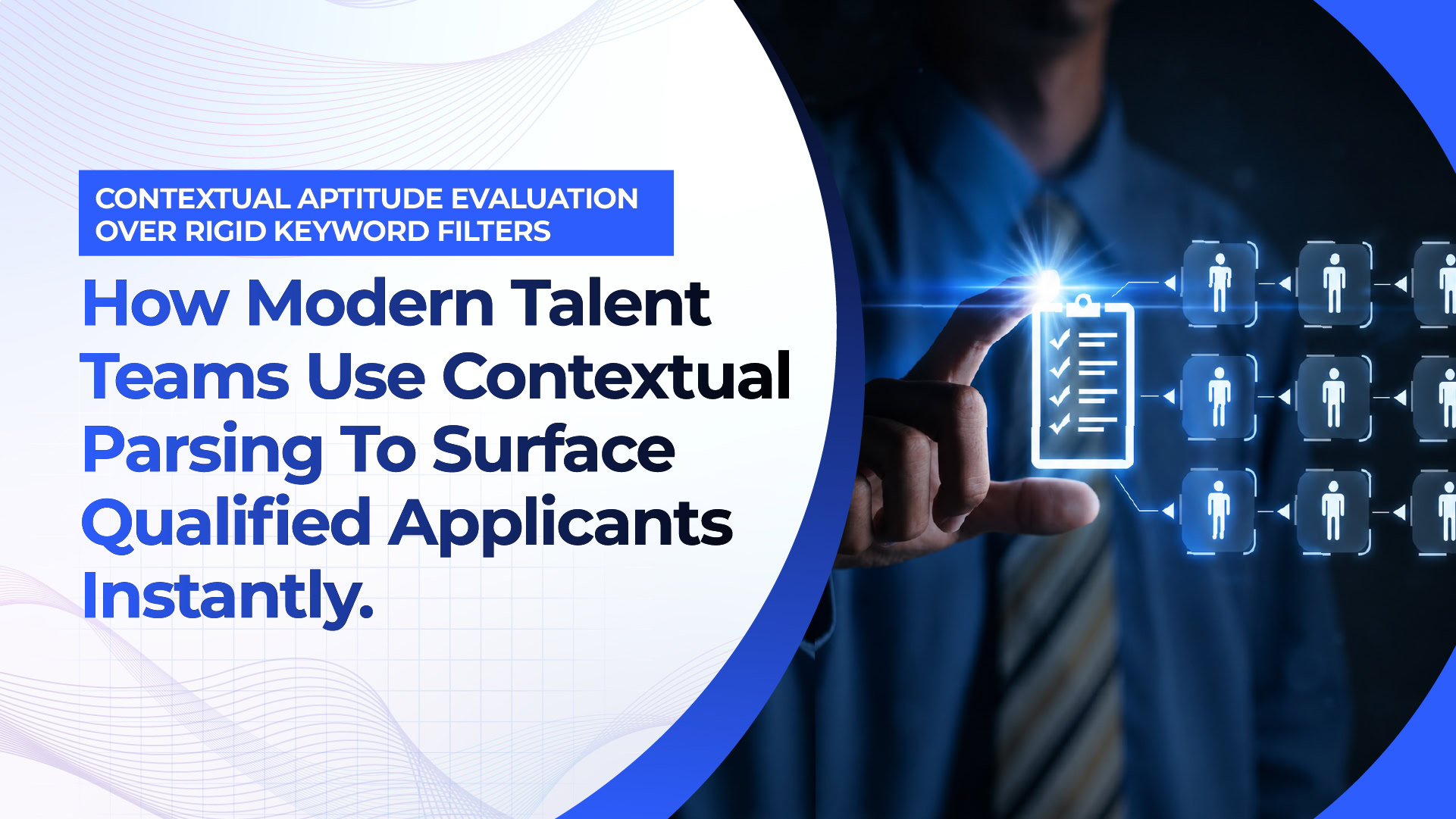
Top-of-funnel candidate evaluation is fundamentally changing. With generative AI tools enabling job seekers to flood career portals with customized applications, talent acquisition teams can no longer depend on manual resume reading or outdated keyword filters.
Modern ai resume screening tools use natural language processing to analyze candidate experience, career progression and skill depth in context. By replacing rigid text matching with contextual analysis, organizations build shortlists grounded on demonstrated ability and evaluate candidates faster.
In this guide, we’ll walk through how automated resume parsing works, how to evaluate its accuracy and bias risks, what to look for when evaluating vendors, and why resume screening is most effective when paired with conversational interview automation.
What is AI resume screening, and how is it different from a keyword-matching ATS filter?
AI resume screening is an automated process of analyzing, scoring and ranking candidate documents using machine learning models that comprehend natural language context.

Conventional Applicant Tracking System (ATS) filters are based on rigid Boolean keyword matching. The old filters would automatically reject a profile if the word “JavaScript” was not found in a resume, but there was deep experience in “TypeScript”.
![HOW AI RESUME SCREENING WORKS [1. Document Parsing] ➔ [2. Entity Extraction] ➔ [3. Contextual Scoring] ➔ [4. ATS Profile Ranking]](https://www.petegabi.com/wp-content/uploads/2026/07/13-info-1-819x1024.jpg)
But an ai resume screening tool considers the semantic meaning behind work history and assesses career progression, the scale of companies, scope of projects and transferable skills so that qualified candidates are not penalized for small phrasing differences.
| Feature / Capability | Legacy Keyword-Matching ATS Filter | Contextual AI Resume Screening Engine |
| Analysis Method | Exact keyword string matching (Boolean logic) | Natural language processing (semantic intent & context) |
| Skill Assessment | Counts specific buzzword occurrences | Evaluates skill depth, usage recency, and practical context |
| Parsing Flexibility | Rejects non-standard layouts or synonym variations | Understands equivalent job titles, certifications, and industry terms |
| Candidate Ranking | Binary pass/fail based on keyword presence | Multi-factor capability scoring with transparent rationale |
How accurate is AI resume screening, and where does it typically get things wrong?
When properly calibrated, ai cv screening software can more accurately and quickly than a human recruiter categorize technical skills, work authorization requirements and tenure.
Gartner research on trends in talent acquisition has identified cost pressures and evolution of technology as reasons for talent leaders to automate initial filtering in order to protect operational bandwidth. But automated document parsing is not without limitations:
- Could not Verify Claim Authenticity: While parsers can analyze the text on a page, they can’t tell if a candidate has the skills they claim.
- Over-reliance on Formatting Structure: Text extraction errors can happen with non-traditional PDF layouts, multi-column tables, or graphic-heavy designs.
- Unconventional career paths leave gaps: If the underlying model favors linear progression, it may misrank candidates who are re-entering the workforce or switching industries.
Document parsing is an early filter for forward-thinking teams, not a hiring decision.
What should you look for in an AI resume screening tool?
Selecting the best ai resume screening software requires evaluating explainability, bias mitigation controls, and technical compatibility with your recruitment stack.
| Feature Area | What to Verify During Vendor Evaluation |
| Explainable Scoring | The tool must provide human-readable rationale detailing why a candidate received a specific score. |
| Bias Testing & Audits | Verify independent third-party audits for algorithmic bias and configurable options to blind demographic data. |
| Bi-Directional ATS Integration | Confirm native connections to tools like Greenhouse, Lever, or Workday to sync scores and notes automatically. |
| Dynamic Skill Taxonomy | Ensure the ontology updates continuously to recognize emerging technologies and shifting job titles. |
To see how conversational screening engines expand on basic parsing, explore our AI Resume Screening Software Hub.
Can AI resume screening reduce bias, or does it risk introducing new bias?
It can do both. Well-designed algorithms reduce the unconscious bias of humans, but poorly trained models can amplify historical hiring disparities.
In fact, SHRM’s State of AI in HR report found that artificial intelligence minimizes subjectivity by evaluating each application against the same objective standards, and safeguards against recruiter cognitive fatigue.
But if an automated resume screening software engine is trained on old company hiring data that favored certain universities or groups, it will mimic those patterns. High-performing tools mitigate this by scoring against objective competency rubrics, not historical employee data sets.
How does AI resume/CV screening fit alongside AI candidate assessment and interview tools?
Automated document screening serves as the initial filter in a multi-stage evaluation pipeline.
![THE COMPLETE AI-POWERED EVALUATION PIPELINE [Stage 1: AI Resume Screen] ➔ [Stage 2: Conversational AI Voice Screen] ➔ [Stage 3: Live Panel Interview]](https://www.petegabi.com/wp-content/uploads/2026/07/13-info-2-1024x576.jpg)
Resume parsing can help you to sort through incoming applications, but document parsing needs to be combined with interactive assessment tools to provide a complete evaluation. When you combine document filters with conversational screening engines such as Rebecca AI Recruiter, you ensure that your candidates are qualified based on live, spoken interaction rather than just on written claims.
For a complete framework on structuring preliminary evaluations, explore our guide on the candidate screening process.
Is AI resume screening enough on its own, or should it be paired with an AI interview step?
Screening for resumes alone is not enough, since static documents show what one writes and not how one performs or communicates.
Hiring teams combine document parsing with an interactive voice interview step to get three key benefits for making confident shortlisting decisions:
- Instant Skill Verification: Real-time investigation of technical claims and follow up questions.
- Synthetic Profile Elimination: Verifies candidate identity to prevent deepfake audio and resume fraud.
- 24/7 Candidate Engagement: Candidates can do screening calls anytime, reducing the time for shortlisting to hours.