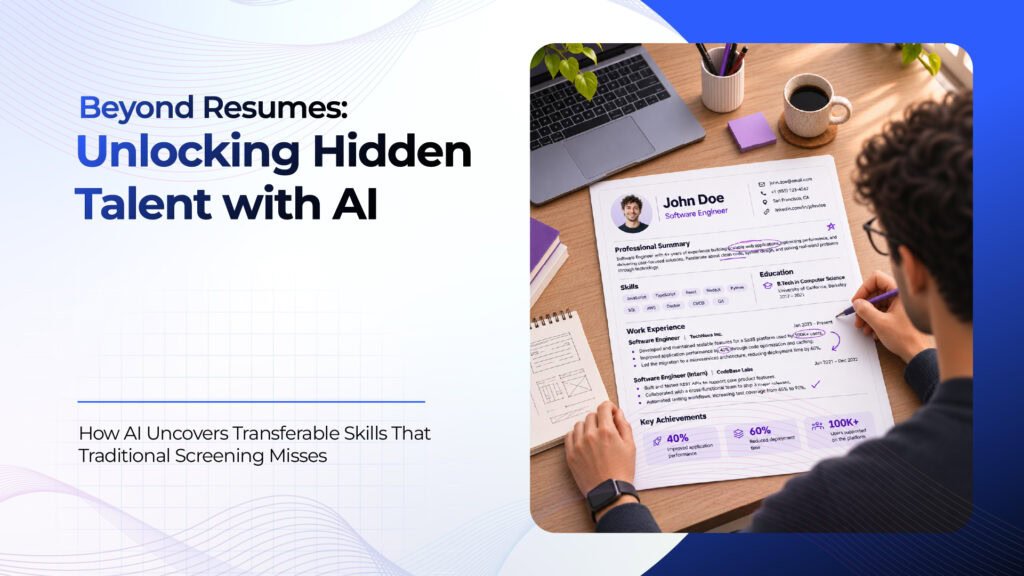
In traditional recruitment, employers match exact keywords, that eliminates qualified candidates from consideration due to various reasons like their job title not matching job description or using a particular term in some specific industry. It has been recently reported that 88% of employers do realize that top candidates are discarded only because they do not get themselves recognized by the automated screening process.
Meanwhile, according to the ManpowerGroup’s 2026 Global Talent Shortage Survey, there are a lot of companies that cannot find suitable employees since 72% of employers worldwide admit that it is rather difficult to fill vacant positions. Despite the ongoing talent shortage, there are more innovative hire seekers who use artificial intelligence to evaluate candidates’ true skills, rather than their job titles.
In the following part, the author will analyze how artificial intelligence works in terms of identification of applicable skills and explain its shortcomings, along with ways of how appropriate verification may narrow the gap between the stated resume abilities and real-life skills.
What are transferable skills, and why do traditional resume filters miss them?
Transferable skills refer to skill sets that can be used for versatile areas of competency such as strategic communication, multi-faceted project management, data analysis, leadership, and customer relationship skills across industries. As an example, a general manager of a restaurant has the operational and crisis management skills that could be very useful for a career in a technology company in operations management or customer success.
Older Applicant Tracking Systems (ATS) do not support this cross-versatility because they have been developed in the era of database keyword indexing, where only a direct string match is relevant according to the database filters. If the title of the applicant does not sound exactly like “Customer Success Manager,” then the filters will immediately eliminate this resume from the list of candidates.
Research organizations such as the Society for Human Resource Management (SHRM) and LinkedIn Talent Solutions periodically show the same effect that the strict approach causes the hiring process to suffer in the form of limited applications. By rejecting the candidates from adjacent industries or unusual backgrounds, organizations make their own job more difficult.
How does keyword-based resume screening overlook qualified candidates?
Using keyword-driven filtering is causing serious structural issues in hiring pipelines:
Exact-Match Blind Spots: Non-traditional candidates often use specific vocabulary to describe their noteworthy accomplishments. A veteran in the logistics field may not be familiar with corporate jargon, that would result in erroneous classification of an experienced candidate, as an inappropriate match for the position of a project manager.
The Cost of False Negatives: The rejection of qualified non-traditional candidates leads to corruption of time-to-fill statistics and higher cost-per-hire. As a result, recruiting departments are competing for a small pool of candidates who possess similar job titles that require higher salaries instead of engaging with readily available workforce.
Absence of Context: Traditional filters rely on the presence of a particular word but ignore its context. For instance, a keyword filter will consider two candidates with the keyword “Python” in their resumes equally qualified candidates: someone who listed it in the course taken three years ago, and who has been using it in enterprise systems in their activities.
Can AI identify transferable skills, and how does it actually work?
AI today has altered the paradigm of analyzing resumes from string-matching based methods to deep semantic understanding.
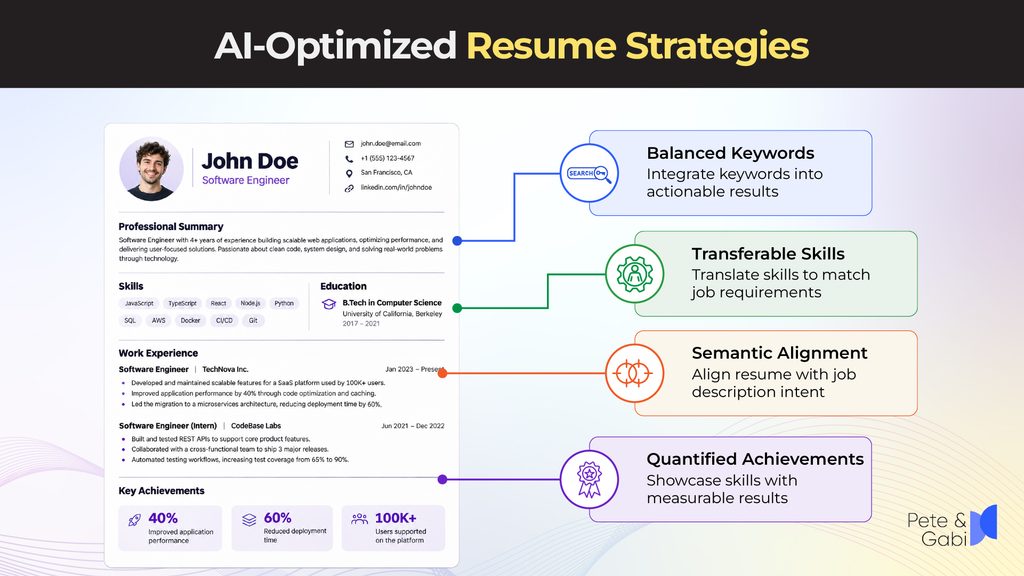
Semantic Analysis & Context Inference
Current-day language models delve into the semantics of work history. Instead of looking for isolated words, the AI tries to connect responsibilities with skills that the job entails and the achievements of the project. For a more in-depth study, see our article about how AI resume screening works and its effectiveness.
Pattern Recognition
AI tools identify similar patterns of competencies across industries. For instance, hospitality management can be seen as an industry that requires competence in real-time dispute resolution, stock management, and human resource scheduling. To get a grasp of analysis-capable software, check out our of AI resume screening software.
Expanding the Talent Pool
Automated skill tagging identifies the best candidates who may not have the usual qualifications. Recruiters can discover promising talent while assessing the skills of the candidates with unconventional job titles. To learn about more ways of applying the technology, read our article on candidate screening best practices.
Where does AI skills inference fall short (and when should a human step in)?
Despite the significant advancement that AI inference technology brings than the standard parsers, the technology is not perfect.
- Ambiguity and Inflated Claims: AI is dependent on words. When it comes to a resume that has the use of jargon, the use of vague words, and/or exaggeration, it might over-estimate a candidate’s capabilities because of the algorithms it uses.
- Nuance in Soft Skills: Text inference is unable to take into account the person’s emotional intelligence, tone of communication, ability to manage stress, and fit into the corporate culture.
- The Human-in-the-Loop Safeguard: It is important to remember that the AI predictions are nothing more than theories. Therefore, recruitment professionals need to be present to avoid possible AI bias caused by this technology. Learn more about ensuring equality in hiring practices from our analysis of top AI hiring assistants to reduce bias.
How can you verify transferable skills beyond the resume?
Resumes only reflect the fact of a candidate being able to state what he or she has done previously or what skills and capabilities the candidate claims to possess, resuming that a real validation needs to go beyond the self-referential text.
For this purpose, structured assessment techniques such as scenario-based exercises and different kinds of interactive assessments provide reliable information about candidate abilities. The introduction of a specific AI voice interviewing technology brings up a new dimension in verification.
What should you look for in AI screening that surfaces transferable skills?
When evaluating tools to identify non-traditional talent, select platforms built on three core pillars:
| Feature Dimension | Evaluation Criteria |
| Taxonomy & Ontology Depth | Supported by extensive, continuously updated skill libraries rather than static synonym dictionaries. |
| Explainability | Delivers clear, transparent rationale showing exactly why and how an adjacent skill was mapped. |
| Customizability | Allows recruiters to adjust weighting for specific adjacent experiences based on role demands. |
To compare options in this space, check out our analysis of the best AI candidate screening tools.
How do you set up a skills-based screening workflow step by step?
Moving to capability-based employment requires a shift in thinking. It’s crucial to change the way we define the job description. Instead of simply directing our attention towards the job title or adhering to strict requirements regarding degrees or previous positions, we should focus on the core competencies of an individual. The use of advanced filtering technologies will allow for comparing jobseekers’ records to their core skills and enabling identification of significant transferable skills that are omitted in standard hiring practices.
In this way, each shortlisted candidate will have a chance to communicate with an AI voice agent. The agent will tell the candidate what skills are necessary for the position, conduct a conversation, and simplify the process of interviewing job candidates. After the interviews, managers will receive already verified resumes and will choose the candidates to possess the relevant skills, thus making it easier to choose between all the candidates.
Transform Your Candidate Evaluation Pipeline
Are you prepared to go beyond fixed resumes and reveal authentic candidate potential? Take your recruitment strategies to a new level with automated and systematic verification of candidates. Try Rebecca AI Recruiter and find out how conversational AI simplifies the recruitment process and see how one of the best AI Video interview software evaluates candidates’ transferable skills.
Frequently Asked Questions
What is the difference between keyword parsing and AI semantic screening?
In keyword parsing, it identifies only the strings searched (for instance, in the case of “Project Manager”) and ignores all types of modifications or adjacent terms. Semantic AI processing carries out an analysis of the meaning, purpose, and connections between the words in the text by determining the potential abilities hidden in the meaning of the text (to illustrate, it may define “event orchestration” as “project management”).
Can AI identify transferable soft skills from a resume?
The potential soft skills can also be established by the means of AI based on the text content, responsibilities, and accomplishments described in it as well. Nevertheless, such deductions remain only as hypotheses that must be verified through practical tests.
Will skills-based AI screening work for candidates with non-traditional career paths?
Yes. In skills-based AI analysis core abilities are analyzed instead of just referring to the job titles, that makes the analysis relevant and applicable to those who are looking for completely new careers, the ones that served in the army; those who are going back to work, etc.
How does voice AI verification support transferable skills assessment?
Voice AI allows getting in touch with candidates through the means of structured verbal interviews that are based on real-life situations. This real-time interaction tests problem-solving capabilities, communication clarity, and practical skills, confirming whether inferred capabilities translate into live performance.