Let’s face a difficult truth: in modern B2B and high-ticket sales, an unanswered phone call or a static contact form is a lead that is actively decaying. When a prospect reaches out, at the peak moment of their intent, every minute you wait dramatically reduces your chances of winning that business.
Industry research consistently shows that delaying your response by just five minutes can cut the likelihood of converting that leads into a qualified opportunity by as much as 10 times. Yet for small sales teams (1 to 10 sellers), a prompt response is often an operational impossibility. Your team is busy with site visits, deep-work client meetings, and crucial demos. They are also sleeping, eating, or managing existing accounts. While they do all this, inbound calls roll to voicemail, and form-fills trigger automated “We’ll be in touch soon” emails that prospects have learned to ignore.
This is the traditional scramble, the acceptable loss. By 2027, accepting missed calls as a cost of doing business will be obsolete. The new standard isn’t just immediate response. It is immediate, intelligent, human-like voice engagement. It’s no longer about calling a lead back; it’s about a conversational AI caller that is ready before they call you. If you’re new to the category, this roundup of the best AI call and phone agents is a good starting point.
1. The Real Mathematics of Missed Inbound Calls
Small teams often fail to quantify the financial impact of their limited bandwidth. They focus on the deals they win, not the revenue evaporating from the leads they never touched.
The Coverage Gap
The logic is simple but devastating: a team of 1 to 10 sellers cannot be present 24 hours a day, 7 days a week. Human time has to be prioritized, and you can’t halt a mission-critical client demo to answer a generic inquiry.
This creates the “Coverage Gap.” Small, dynamic teams commonly miss between 40% and 60% of incoming inquiries. These missed connections aren’t just spam. They include key decision-makers who reach out while your team is busy with other priorities.
The Competitor Advantage
If the coverage gap explains why calls are missed, this statistic explains why it’s so lethal to your pipeline: the first business to verbally engage a prospect wins the deal over 70% of the time.
In a landscape of commodity alternatives, responsiveness is the ultimate differentiator. Prospects are in problem-solving mode and want a solution now. Waiting hours, or even 30 minutes, for a human callback gives them time to search, click, dial, and quite possibly speak with your competitor. You didn’t just lose the lead; you lost it to the faster vendor.
The Cost of Voicemail
We live in an asynchronous culture. Modern B2B buyers rarely want to leave a message, and they don’t trust that their voicemail will be returned in a timely manner, if ever. Many find the process archaic.
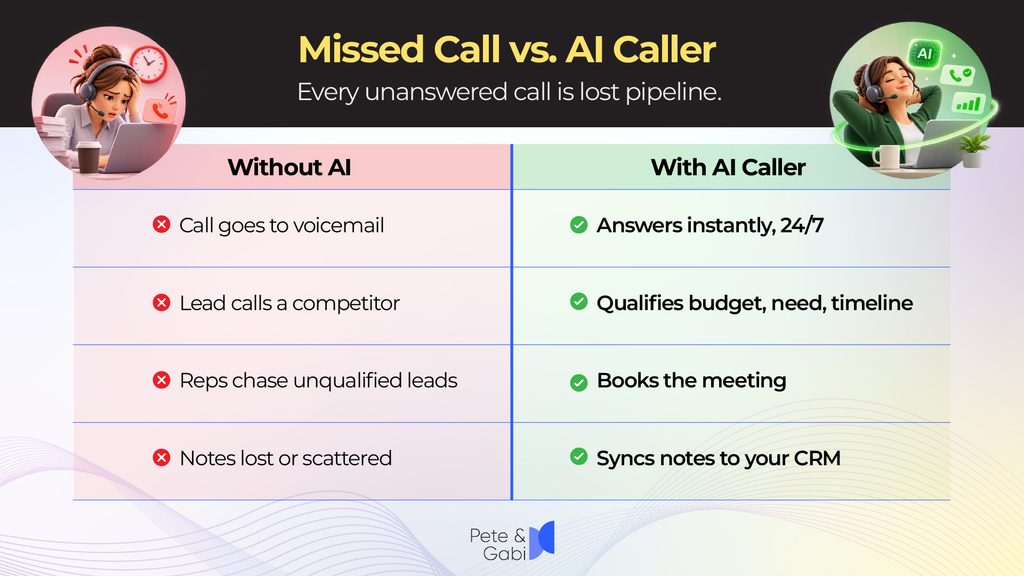
When a high-intent prospect hits a voicemail box, they simply hang up and dial the next competitor on their list. A voicemail box isn’t a capture tool. It signals to your lead that you are not open for business when they are ready to buy.
2. Why Static Missed-Call Texts and Web Forms Fall Short
Small businesses often try to bridge the responsiveness gap with band-aid technology, but these tools fall short when the conversation requires nuance and high-value decision-making.
The Limits of Auto-SMS
The most common “modern” fix is a basic missed-call text-back tool. When a call is missed, the system sends a pre-written text: “Sorry we missed your call. We will get back to you soon!”
That’s better than silence, but it has fatal flaws. It can’t handle logic, nuance, or technical questions. A prospect who calls asking, “Does this system integrate with Salesforce?” or “I need to know your minimum pricing before I waste my time,” gets a generic text that ignores the question. These tools are static placeholders, not engagement engines.
The Missing Conversational Loop
Static web forms and asynchronous emails are equally passive. They leave the prospect in an informational vacuum. A lead fills out a form during a lunch-hour search, hopes for a confirmation page, and then waits.
That wait state drains intent. There is no opportunity to answer objections, ask qualifying questions, or confirm the prospect is in the right place. By the time your team is free for a manual callback, the peak moment of curiosity and readiness has passed.
3. How Conversational AI Voice Agents (Like Olivia) Operate 24/7
This is where the paradigm shifts from passive delay to proactive, real-time voice intelligence. A conversational AI voice agent like Olivia is not an answering service. She is a capable team member who never sleeps and is always at her desk. Petegabi’s AI inbound call agents are built around exactly this idea.
Instant Sub-Minute Response
The primary superpower of an AI voice agent is speed. The moment a prospect fills out a form, triggers an inbound web event, or rings your office phone and lands on the voicemail route, Olivia initiates a connection.
Instead of waiting for a manual callback scheduled “sometime today,” the prospect is speaking with a representative of your company within seconds of their inquiry. Intent is captured at its highest velocity.
Dynamic Natural Cadence
Forget rigid, frustrating IVR phone trees that command callers to “Press 1 for sales.” AI agents like Olivia use Natural Language Processing (NLP) to hold fluid, natural, turn-by-turn conversations. She can handle interruptions (“Wait, before you continue, does it work with Outlook?”), understand complex phrasing, and answer questions with the right tone and logic. The uncanny valley of voice AI has largely been crossed. These interactions feel conversational and helpful, not robotic and demanding.
4. Real-Time Qualification and Automated Calendar Sync
If speed is the first advantage, qualification is the second. Olivia doesn’t just pick up the phone. She runs the critical first-level sales discovery.
Core Discovery Execution
Your small team needs to focus on hot pipeline, not tire-kickers. Olivia walks prospects through your baseline qualification criteria in a natural way:
- Budget: “To make sure this solution aligns with your project, what is the approximate budget you’ve allocated for this initiative?”
- Timeline: “Are you looking to implement a solution this quarter, or are you in the earlier, informational stages?”
- Scope: “Are you looking for a system with just core data entry, or do you also need the advanced analytics module?”
She gathers BANT (Budget, Authority, Need, Timeline) and project details live, without sounding scripted or invasive.
Frictionless Booking
The definitive moment of mid-funnel success is not qualification. It is the meeting. Olivia is integrated directly into your team’s calendar.
Once Olivia confirms the lead meets your thresholds (for example, the right budget and a need next month), she moves straight to securing the meeting: “It sounds like we’re an excellent fit for your needs. The next step is a detailed demo with our specialist. Would you prefer a meeting this Tuesday afternoon, or Wednesday morning?”
The meeting is confirmed and placed on the right Account Executive’s calendar before the call ends. The lead isn’t sent a link to book later. They’re secured at the peak of their intent.
5. Unifying Voice, SMS, and CRM Architecture
An AI agent isn’t a solitary operator. It is an integrated part of your software stack, handling the administrative work human sellers loathe.
Multichannel Synergy
The call is just the beginning. Immediately after it ends, Olivia sends a personalized SMS summary with a link to the resources the prospect just discussed, such as a technical specification PDF or pricing sheet. Conversational momentum carries across channels, reinforcing that yours is a professional, high-touch operation.
Zero-Touch Data Entry
This may be the biggest quality-of-life improvement for your team. AI agents eliminate manual CRM note-taking. The moment the call ends, Olivia writes the full interaction record into your database, including the call transcript, a sentiment read (for example, “Lead was highly eager and positive”), and qualification tags (for example, “Qualified: Budget>50k” or “Unqualified: Looking for different solution”). Your sellers open their CRM and the full context is waiting.
6. Filtering Out Spam and Protecting Team Bandwidth
The value of speed and qualification isn’t just winning deals faster. It’s protecting the focus of your most asset: your human sellers.
Guarding Human Focus
For a small team, context-switching is devastating. Interrupting complex closing work to field robocalls, unqualified solicitations, or tire-kickers who “just wanted to ask a quick question” derails productivity.
By 2027, small teams will let AI absorb that friction. AI agents act as the ultimate goalie, screening the initial inbound noise. Your sellers are never notified about spam bots, solicitations, or unqualified leads. When a calendar alert appears, they know it’s a live, qualified opportunity with full notes, ready for a closing conversation.
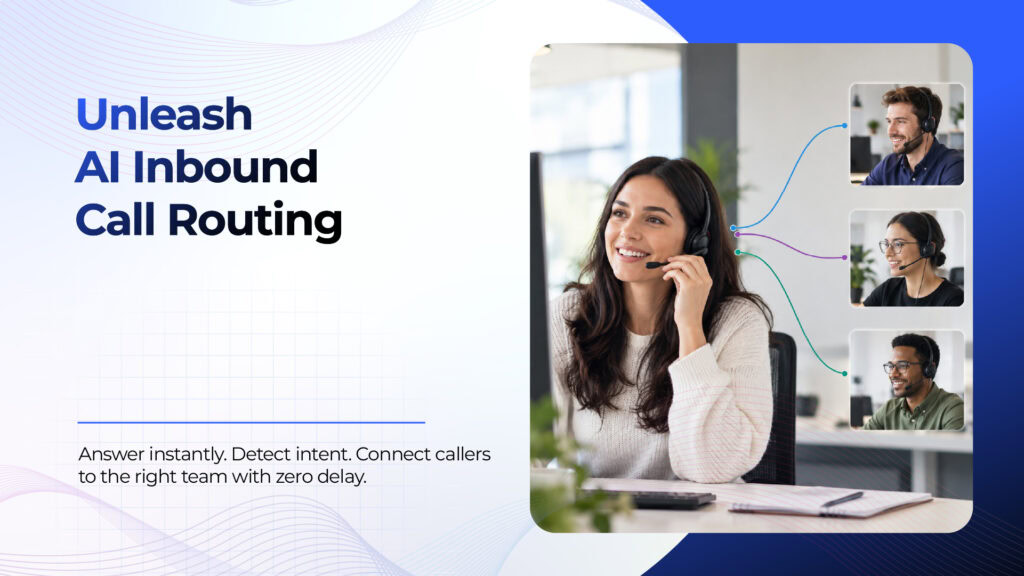
Smart routing adds another layer. With AI call routing and smart dispatching, hot leads reach the best-fit rep automatically, which lifts conversions. The AI filters the pipeline so humans can focus on closing it.
7. Conclusion and Strategic Roadmap for 2027
The standard has changed. Small sales teams of 1 to 10 people can no longer treat missed inbound calls as an acceptable, unpreventable cost of doing business. In the competitive mid-funnel, the price of silence is lost revenue and a decayed pipeline.
The math of missed calls shows the coverage gap is real and the cost of voicemail is absolute. Static text-backs and passive web forms provide no refuge. The only viable path to revenue acceleration is immediate, conversational intelligence.
Before you commit to any platform, it pays to know what separates a good one from a gimmick. This guide on what to look for in AI receptionist software covers voice quality, integrations, and handoff.
AI agents are not the science fiction of the future. They are a strategic necessity now. By deploying natural voice agents like Olivia, small teams bridge the gap between initial inbound intent and immediate revenue action. In 2027, the question won’t be “Should we automate our first-round calling?” It will be “Why haven’t we done it yet?”
Ready to Stop Losing Leads?
Stop letting leads decay while your team works. Learn how the Pete & Gabi platform and our voice agent, Olivia, can turn your missed call volume into a qualified, calendar-booked pipeline. Explore the future of voice engagement and check our pricing options here.
Frequently Asked Questions
What is the financial impact of answering inbound leads in under 60 seconds?
Industry data shows conversion likelihood can drop by up to 10x if an inbound lead isn’t engaged within the first five minutes. Instant AI calling within a sub-minute window captures prospect intent at its peak and maximizes your pipeline potential.
How is an AI voice agent different from basic missed-call text-back software?
Text-back tools rely on static, generic SMS templates. Conversational AI agents like Olivia hold live, fluid, two-way voice conversations. Olivia can answer qualifying questions, handle technical nuance, and book a meeting directly into your calendar, capturing the commitment live.
Can small sales teams of 1 to 5 people realistically manage an AI voice setup?
Yes. This technology is built for low-maintenance deployment. Olivia handles peak inbound call surges automatically and routes only qualified, ready-to-close meetings onto your team’s calendars.
How do voice agents filter out spam callers and robocalls?
The system uses intent recognition and conversational verification to screen out automated robocalls and low-intent inquiries before they reach your team’s notification channels. Your team sees only live pipeline opportunities.