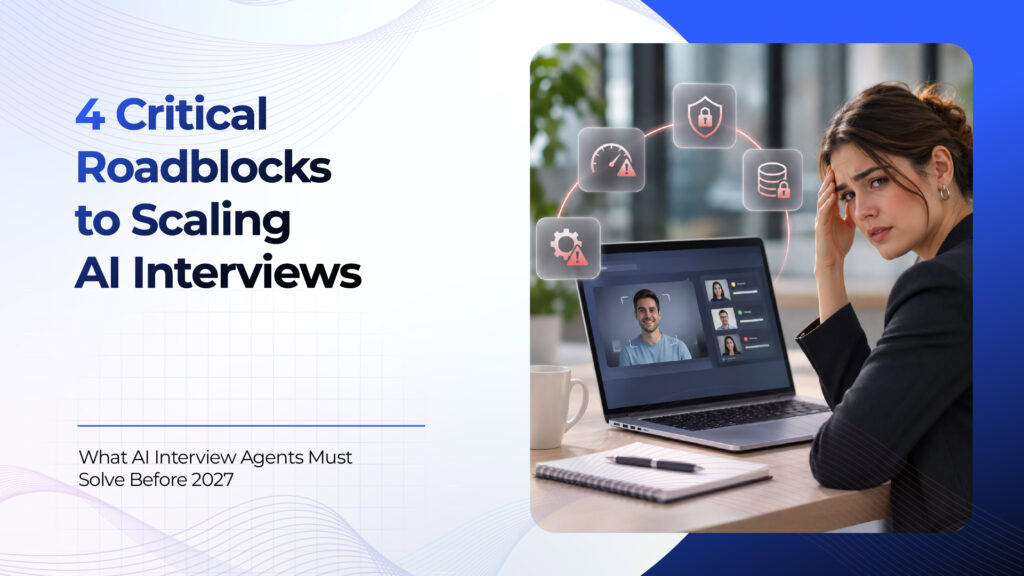
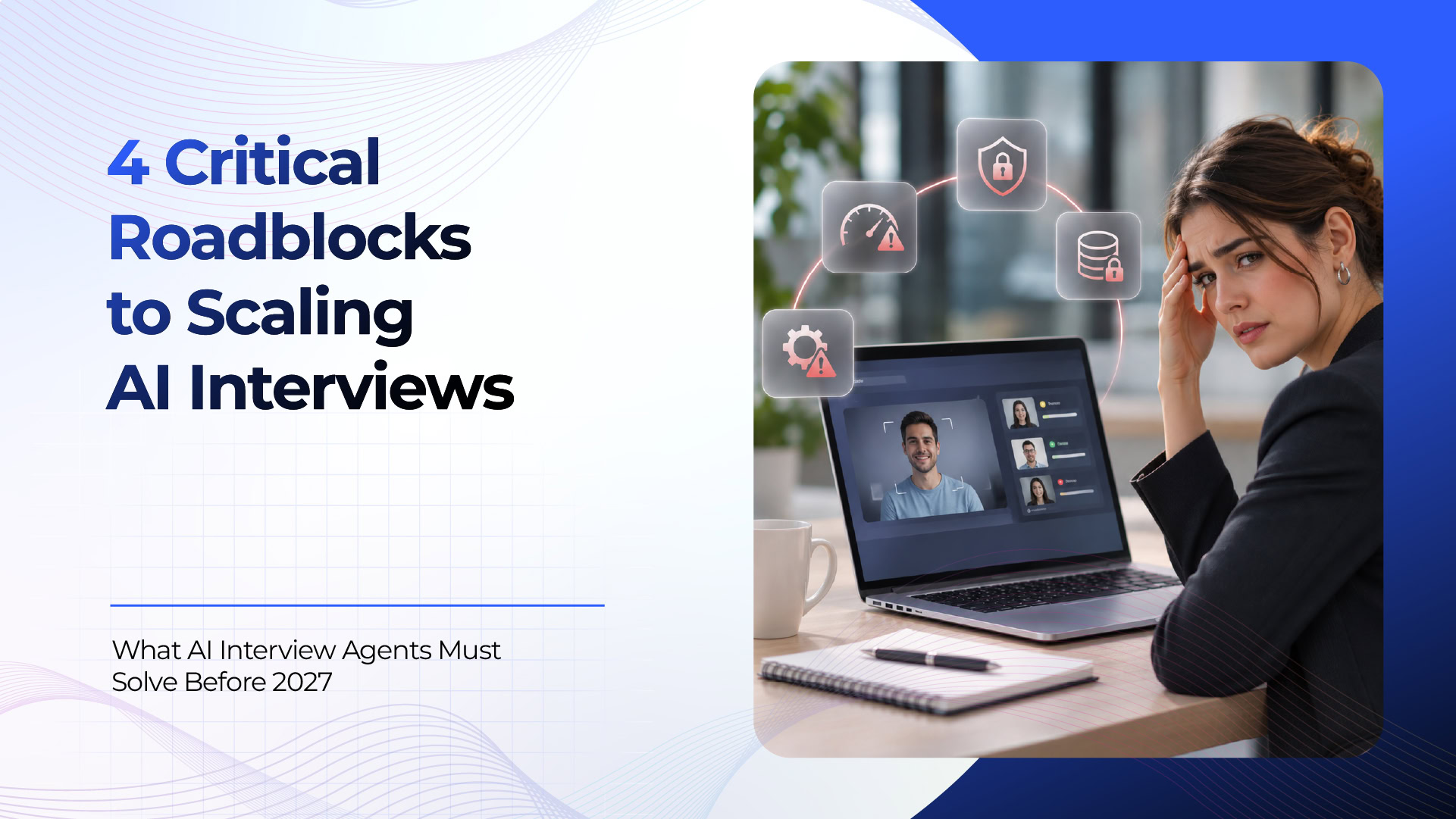
Automated video interviewing has made its mark in high-volume recruitment. It is good for basic things, like checking availability, verifying basic qualifications, and organizing numerous candidates into groups. However, when implemented broadly across regions and roles, the organization runs into all sorts of problems. It is not about lack of features but rather systemic limitations.
This is known as the paradox of scale: what works flawlessly in small batches can produce many risks when applied to a larger group. Automation that allows one to conduct 200 video interviews a month will most likely break down when the number of applications jumps to 200,000, if the system of interviewing cannot identify who is speaking on the camera.
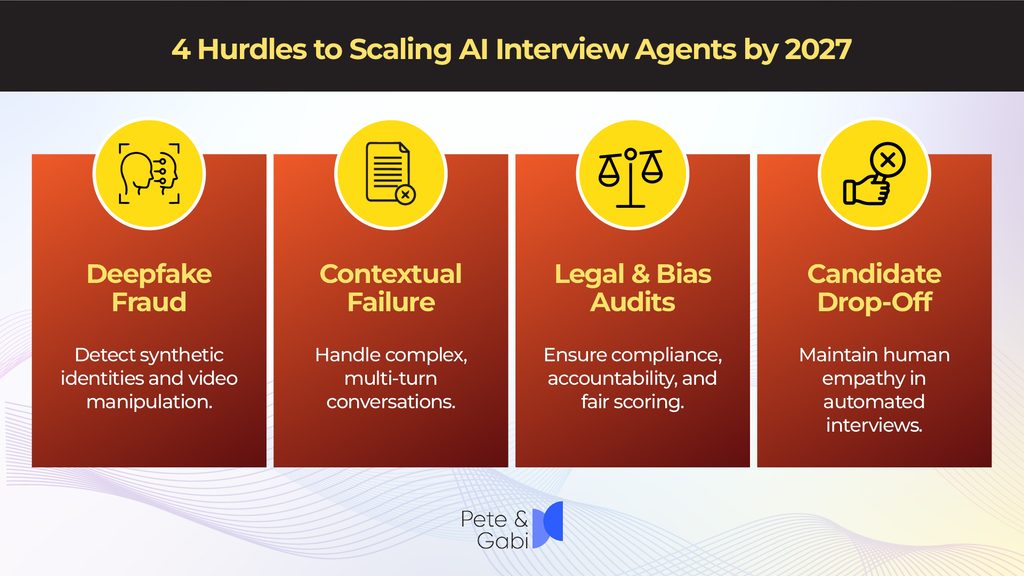
This is also the reason the discussion has moved beyond the early chatbot-based solutions. Keyword-based applications are limited in functionality and can only engage in superficial conversation. However, true AI recruiting tools still have the ability to actively engage in conversations with candidates and challenge their thoughts. 1. Eliminating Synthetic Identity Fraud and Deepfake Evasion
The emerging threat: Hiring remotely has opened the door to new risks. Job seekers, along with organized hacking gangs, can now use artificial intelligence to make real-time changes to their face and voice so that they can take a job interview. The person hired may not be the same person in front of the camera. Experts and authorities have been warning about the dangers of deep fakes and synthetic media already.
Why verification architecture matters: Current webcam access checks only ensure that the camera is turned on, but do not prove that its video stream is real. To protect against synthetic media, you need to check that the camera video, sound device and environment all work properly together. One option worth investigating is to use a special program based on remote checking technology.
Balancing security and privacy: A choice must be made. The more intensively a computing environment is evaluated by the platform, the greater the likelihood that public trust will be lost or that privacy laws will be violated. The solution is proportionality: data collection should be limited to what is necessary for ensuring integrity, and candidates should be informed of what checks are performed, as well as why. Furthermore, employers should obtain candidates’ consent and undergo checks. Data collection must be limited in compliance with regulations such as GDPR.
To delve deeper into the requirements of data protection in recruitment, you can refer to our guide centered on the GDPR compliance for AI interviewers as it discusses the points related to privacy and compliance that the recruitment heads will need to know while using AI interview technology.
2. Contextual Nuance and Multi-Turn Reasoning Failures
The rigid script problem: Legacy evaluation methods presume job seekers to respond to one inquiry at a time and in order. However, candidates do not behave this way. They provide non-linear responses, address the future question in advance, or combine multiple thoughts in a single reply. A strict protocol will fail either to satisfy candidates’ non-linear replies or to discriminate among applicants effectively. As a result, the very smart and strong applicants are the ones that do not make it to further rounds.
Dynamic branching: This is a real technical problem to solve. An interviewer ought to possess a very rich memory component to keep track of what has been said at least 10 minutes ago, identify discrepancies between previous and latest responses, and determine which question to ask next. The most advanced two-way AI interview agents work as skilled interviewers; i.e., they listen to their candidates and adjust their behavior accordingly.
Evaluating ambiguity: Staffing decisions frequently depend on an individual’s solutions to situations that have no solely correct responses. AI hires that only rely on the matching of keywords will favor candidates repeating certain terms, while ignoring those who provided relevant arguments in simple language. Going forward requires being able to evaluate disparate types of problem-solving rational analysis.
3. Navigating the Evolving Legal and Compliance Landscape
Algorithmic accountability: Recruitment is arguably the most over vetted application of AI technology. The EU AI Act defines all AI connected with recruitment as a high-risk type of technology, thus imposing strict requirements in terms of transparency, human intervention and accountability. In the US, NYC local law 144 states that any AI systems which make decisions related to applicant recruitment should undergo a bias check and provide information to every candidate.
Bias auditing and explainability: Hiring leaders will no longer accept arbitrary outcome data. Scoring methods now require strong audit trails based on job-related factors for any evaluation method. Lack of transparency in decision-making is a disadvantage in the hiring process. A process that is transparent, using continuous monitoring in line with standards such as the NIST AI Risk Management Framework, allows organizations to demonstrate that their hiring process is fair, valid, and objective.
While evaluating the issue of scoring transparency, it is necessary for the companies to investigate the criteria they use to make selections. In that respect, our article on Cultural Fit vs. Cultural Add explains how companies can create teams that still will be free from subjective cultural preferences.
Audit trails. Any time when the hired individual’s performance is questioned, it does not mean that memories about what happened can be taken as evidence of how the hiring process was conducted. In fact, it’s necessary to have recorded transcripts and structured behavioral reports that HR department and lawyers will find useful to assess the quality of the process. AI video-interview platforms need transparent auditing for reliable, accountable operations.
4. Preserving Human Empathy in Automated Evaluations
The cold tech backlash: Job seekers can tell when they are being interacted with by an emotionless entity. Robotic and overtly transactional communication leads to losing candidates, harming employer branding, and losing high-quality candidates to competitors. Overall, efficiency that costs organizations their best candidates is not an indicator of efficiency.
Tone and pacing calibration: Empathy can be designed. This involves natural rhythm of conversation, proper pauses coming at the right moment and giving a chance for candidates to think, active listening cues that indicate that the agent is aware of what the candidate said, and a warm tone without being too dramatic. The goal is to be able to maintain and perfect the conversation without trying to imitate a human being accurately.
Candidate experience metrics: What is measured can be managed. The leaders of the hiring process have specific KPIs to keep track of and they are making sure that their AI is meeting those metrics and maintaining its performance across technical tasks, both despite all difficulties. A very challenging interview process can bring positive experience at the end if everything is organized the right way.
How 2027 Leaders Are Building Resilient AI Screening Stacks
Companies that take care of these four vital issues will gain a competitive advantage in being able to hire at lightning speed, as they will earn the trust of candidates that may be quite difficult for rivals to achieve. Trust, compliance and goodwill build over time, but shortcuts will not allow companies to penetrate this barrier.
The resilient AI interviewing stack of the year 2027 has four essential elements: proven identity, contextual understanding, sound compliance, and real candidate experience. This is the level of security that Rebecca AI communicates with its clients – as a pioneer of highly secure AI interviewing technology: check how it works in practice by exploring the two-way AI interview agents, studying the key features of the best AI video interview platforms, or visiting our company website, Pete & Gabi, and starting the building of your own interviewing stack that is ready to scale.
Frequently Asked Questions
1. What technical challenges must AI interview agents overcome?
AI interviews agents should be knowledgeable of contextual answers, deal with interruptions properly, keep the conversation flowing, and recognize fake identities and audio deception attempts in remote interviews.
2. How does Rebecca AI evaluate candidates without relying on rigid scripts?
Rebecca AI employs dynamic conversations relevant to every role and candidate’s feedback and allows the company to report not only on clear communication but on intentions and skills needed for the job as well.
3. How do AI interviewers handle audio delays, connectivity issues, and background noise?
AI interviewers use real-time audio processing technologies to eliminate noise and make the conversation smooth. The ability of an AI interview to deal with interruptions depends on the voice technologic structure and network conditions.
4. How does Rebecca AI protect candidate data during interviews?
Rebecca AI employs enterprise security tools such as encryption, access control, and application of data safety practices such as SOC 2, ISO 27001, and GDPR.
- How do AI video interviews detect deepfakes and proxy candidates?
Good AI platforms use real-time multi-sensors checks to verify devices instead of using the permission request for the webcam. Rebecca Guard, the member of Rebecca AI recruitment software, is designed to confirm that the interview takes place remotely, on a legitimate device, with a genuine, real person.