You can not properly evaluate recruitment technology by looking only at surface level features. You also have to consider financial return, operational velocity, and business impact. With the increasing volume of candidate applications, manual resume reviews and repetitive phone screenings drive up cost-per-hire and lengthen hiring timelines.
Contemporary screening tools deliver measurable recruitment automation results through autonomous early-stage candidate assessments. By deploying conversational voice engines to screen applicants 24/7, talent acquisition teams significantly reduce time-to-hire, regain hundreds of recruiter hours and lower overall talent acquisition costs.
This guide breaks down how to calculate the AI ROI of video interviewing, looks at a real-world staffing case study, lists key performance metrics, and discusses how financial returns differ across high-volume and enterprise hiring environments.
What ROI should you realistically expect from AI video interviews?
In practice, enterprise organizations should expect a 3x to 5x return on software investment within the first 90 days of deploying automated screening tools.
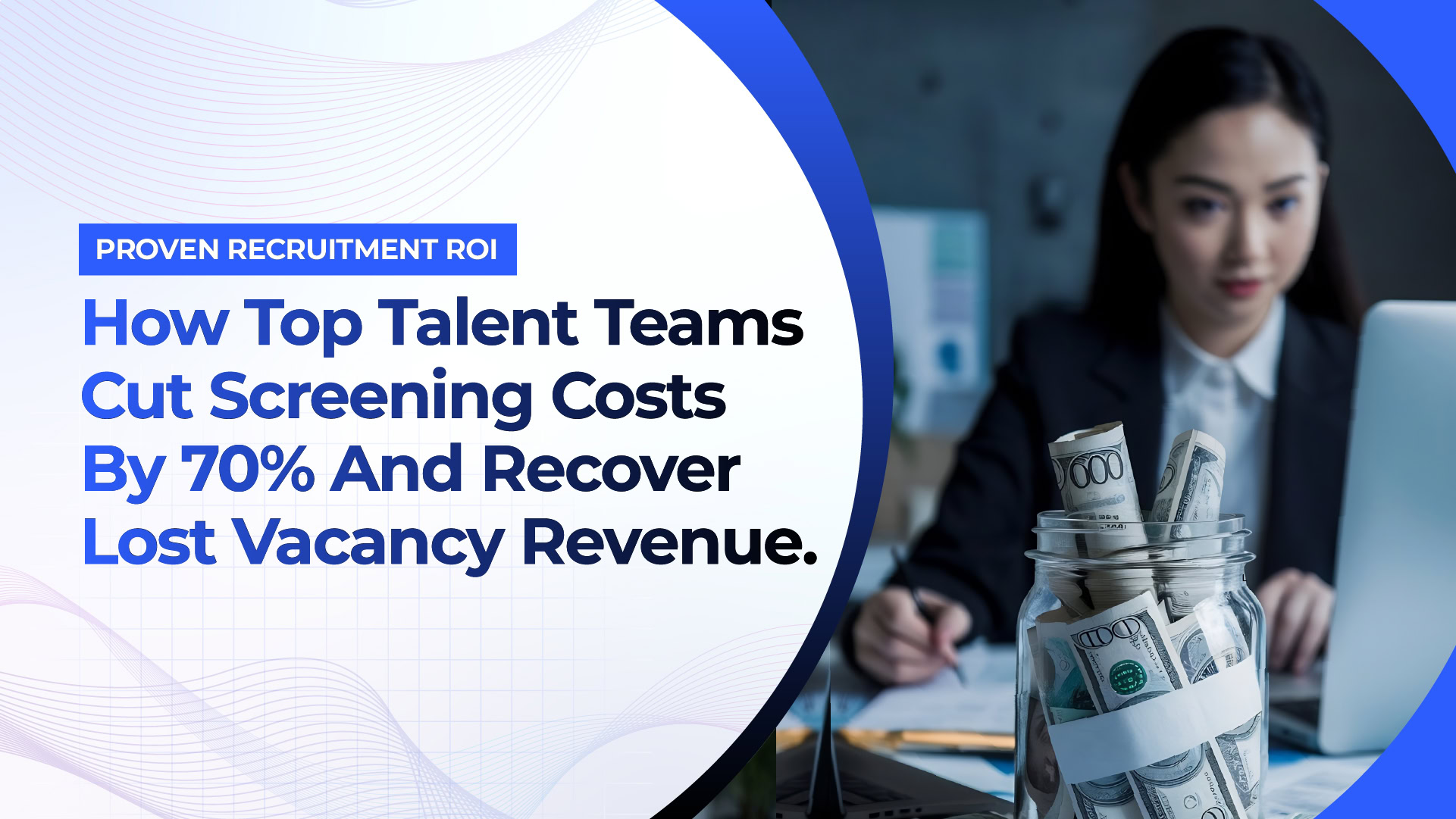
Talent leaders should be measuring three financial levers for AI interview ROI: direct labor savings by reducing screening hours, revenue recovered by getting to revenue-generating seats faster, and third-party agency fees.
Enterprise leaders look at three critical inputs to calculate the true financial ROI of recruitment automation:
- Labor Cost Savings: The immediate value of recruiter hours saved from manual phone screening, resume parsing and scheduling emails.
- Revenue Recovered from Vacancy: The dollar value of filling sooner revenue generating or billable open seat days.
- Total Tool Spend: The cost per year for a subscription to your conversational AI screening platform.
- The Bottom Line: Net ROI is calculated by adding your labor savings to your recovered revenue, subtracting the software cost and dividing that number by your initial platform investment.
To calculate the total ROI of video interviewing in recruiting, you need to measure these performance benchmarks across your talent pipeline:
- Recruiter Capacity Expansion: 12-18 hours per recruiter/week are freed up from manual screening calls and calendar scheduling.
- Direct Cost Reduction: Reduces total screening and administrative cost-per-hire by 60 to 75%.
- Pipeline Acceleration: Cuts initial screening and shortlisting cycles from two weeks to less than 48 hours.
- Empty-seat revenue protection: Limits loss of revenue from long-term unfilled sales, technical and billable service positions.
Try our interactive Recruitment ROI Calculator to see your organization’s unique financial return based on your current applicant flow and team size.
Case study: how a staffing team cut time-to-hire with Rebecca
Peterson Technology Partners (PTP) reduced initial candidate screening times by more than 70% by using Rebecca AI to perform autonomous initial candidate qualification.
As volumes of candidates across technical and staffing requisitions grow, traditional recruiter screening quickly becomes an operational bottleneck. Peterson Technology Partners implemented Rebecca AI Recruiter to automate top of funnel technical screening and qualification calls.
Case Snapshot Card
- Company Profile: Peterson Technology Partners (PTP) — IT Staffing & Enterprise Consulting
- The Operational Challenge: Recruiter inboxes were flooded with inbound application volumes which caused long review backlogs, slow candidate response times and recruiter burnout.
- The AI Solution: Integrate Rebecca AI Recruiter as an interactive voice screening step for 24/7 applicant engagement, technical skills validation, and direct upload of structured scorecards into their ATS.
- The Verified Results: 11,833 candidates processed with not one recruiter doing a manual phone screen. Keeping candidate satisfaction high, while drastically cutting screening delays.
“Rebecca AI transformed our initial screening from a multi-week bottleneck into an instant 24/7 engagement process. Our recruiters spend zero time playing phone tag and 100% of their energy interviewing fully vetted, high-fit technical talent.”
— Talent Acquisition Leadership, Peterson Technology Partners
For a complete breakdown of the implementation workflow and full dataset, read our detailed case study on how Rebecca AI processed 11,833 candidates without a single recruiter.
What metrics actually move (time-to-hire, cost-per-hire, recruiter hours, offer-acceptance)?
Automated candidate interviewing improves critical metrics such as time-to-hire, cost-per-hire, weekly recruiter hours saved, and candidate offer-acceptance rates.
TrackingAI video interview results means tracking changes in four core metrics in talent acquisition:
- Time-to-Hire: Traditional screening is a series of 15 minute phone calls during business hours. Conversational voice systems have the ability to engage candidates immediately after they have submitted an application, reducing initial screening time from weeks to 24 hours.
- Recruiter Hours Reclaimed: Recruiters spend up to 40% of their work week on repetitive introductory calls and manually typing summary notes. By automating those screens, recruiters get back 15+ hours per week to build relationships and advise hiring managers.
- Cost-Per-Hire: Direct screening can be expensive, and when automated evaluation systems take place of manual phone calls, costs are significantly reduced. Learn how slow hiring hurts company profitability in our analysis of how slow hiring is costing you revenue and how AI can fix it.
- Offer acceptance rates: Quick responsive communication leaves a positive impression on the candidate. The quicker you can screen candidates and provide timely feedback, the more likely candidates are to accept an offer in competitive roles.
How does AI interview ROI differ at high-volume vs. enterprise/niche hiring?
AI interview ROI differs because high-volume hiring drives financial returns through candidate throughput and recruiter capacity, whereas enterprise hiring drives returns through vacancy cost recovery, fraud prevention, and quality of hire.
Calculating AI recruiting ROI across different organizational structures reveals distinct financial drivers:
| Financial & Operational Dimension | High-Volume Recruiting Teams | Enterprise & Niche Hiring Units |
| Primary Financial Lever | Recruiter hour savings & candidate throughput scaling | Vacancy cost reduction & candidate evaluation precision |
| Main Bottleneck Solved | Massive resume backlogs & calendar scheduling tag | Complex technical skill vetting & deep candidate qualification |
| Scaling Impact | Process thousands of candidates without adding headcount | Standardize rubric scoring & enforce strict hiring compliance |
ROI of High-Volume Recruitment
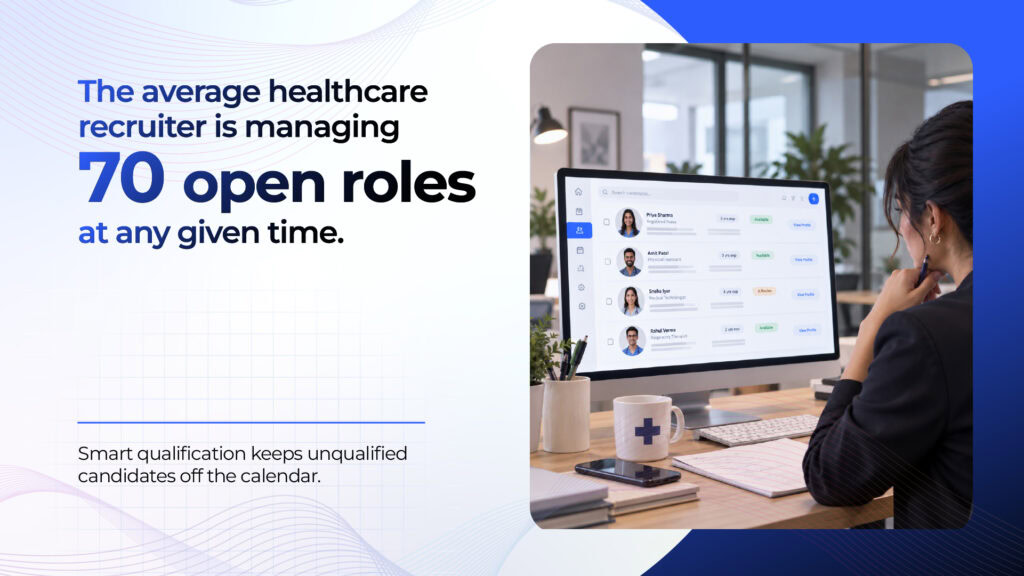
In high-volume sectors like healthcare, retail, customer support and commercial staffing, returns are a function of volume capacity. Automate candidate screens to evaluate thousands of applicants simultaneously without adding additional recruiter seats, while drastically reducing interview no-shows with instant self-scheduling.
See how staffing organizations leverage voice automation for a competitive edge in our guide on how voice AI shortens time-to-hire for staffing firms.
Enterprise & Niche Hiring Return on Investment
In specialized enterprise AI recruiting environments (technology, financial services, engineering) returns come from the quality of evaluation, compliance, and vacancy cost recovery. Advanced conversational agents act as a firewall in operations, validating technical skills and detecting deepfake audio or synthetic candidate profiles before hiring managers invest time in live panel interviews.
See What Rebecca AI Can Do for Your Pipeline
When it comes to measuring ROI on recruitment technology it’s all about proven results: faster pipeline velocity, lower screening overhead and more satisfied candidates.
Rebecca AI Recruiter provides the conversational screening infrastructure that enterprises and high-volume teams need to assess candidates 24/7, remove screening friction, and scale hiring capacity efficiently.